A plant that produces five different hallucinogens at once has been developed through genetic engineering.

Israeli scientists have announced that they have successfully extracted genes that produce hallucinogenic substances from mushrooms and toads and incorporated them into a single plant, resulting in the extraction of five different hallucinogenic substances from that plant.
Complete biosynthesis of psychedelic tryptamines from three kingdoms in plants | Science Advances
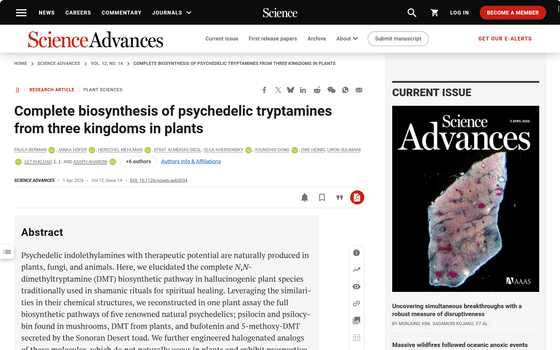
Scientists Engineered a Plant to Produce 5 Different Psychedelics at Once : ScienceAlert
According to Paula Berman and colleagues at the Weizmann Institute of Science in Israel, existing chemicals used to make hallucinogens are mainly extracted from rare plants, fungi, and animals, but these are becoming difficult to conserve due to habitat loss and other factors. Therefore, methods are being explored to replace them with plants that grow faster and are easier to harvest.
To address this challenge, Berman and his colleagues worked to elucidate the pathways through which the chemicals are produced.
Berman and his colleagues analyzed
Tobacco benthamiae is a fast-growing species widely used in plant research. In recent years, it has been used in the development of influenza vaccines, among other applications.
'Plant-derived influenza vaccine' emerges, effectiveness confirmed in large-scale clinical trials - GIGAZINE
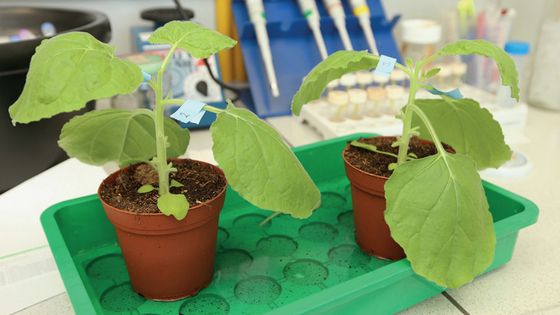
By introducing multiple genes, it was confirmed that tobacco benthamiana simultaneously produces five hallucinogenic substances: dimethyltryptamine from the plant, psilocin and psilocybin from the mushroom, and bufotenin and 5-methoxy-N,N-dimethyltryptamine from the toad.
However, because different synthesis pathways compete for the same resources, some compounds were produced in smaller quantities compared to the original organism. Nevertheless, with some adjustments, Benthamiana tobacco is likely to be beneficial to scientists.
Berman and his colleagues stated, 'Our strategy is to establish a system for producing five key compounds with high therapeutic value and deliver them through plants. By combining the integration of catalytic functions in plants with metabolic engineering, we have been able to significantly improve the efficiency of production.'
ScienceAlert, a science media outlet, reported that 'as interest in hallucinogens grows as a treatment for conditions such as depression, anxiety disorders, and PTSD, this system could provide scientists with a new way to obtain hallucinogens.'
Related Posts:



in Science, Posted by log1p_kr