In fact, Voyager 1 is still functioning with 69KB of memory and an 8-track tape recorder.
by
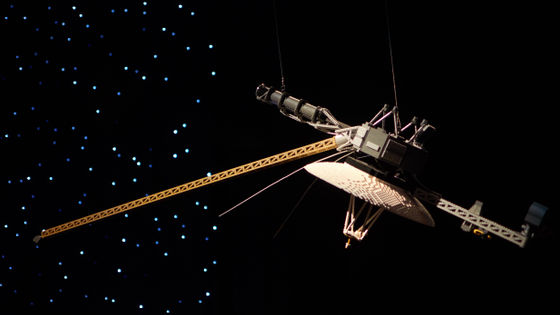
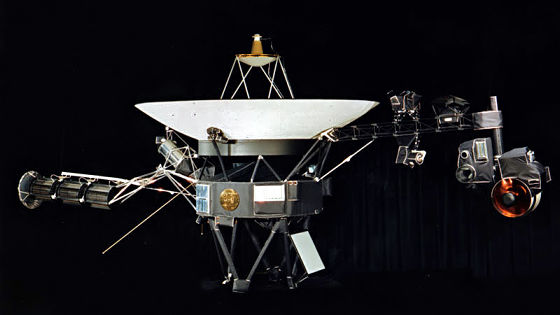
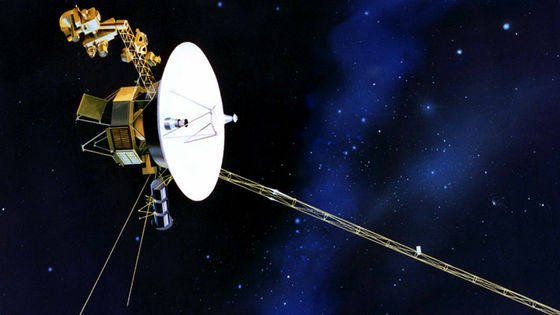
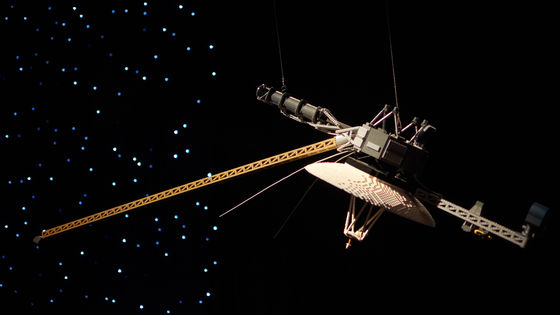
The Voyager 1 space probe, launched into space carrying information about Earth, is the farthest man-made object from Earth in the universe. Despite having only a memory capacity about one-hundred-thousandth of that of a modern smartphone, Voyager 1 continues to function nearly 50 years after its launch.
A 1977 Time Capsule, Voyager 1 runs on 69 KB of memory and an 8-track tape recorder
https://techfixated.com/a-1977-time-capsule-voyager-1-runs-on-69-kb-of-memory-and-an-8-track-tape-recorder-4/
Voyager 1 is a space probe launched on September 5, 1977, carrying the '
Voyager 1 continues to transmit scientific data to Earth from the farthest point in space that no existing instrument can collect, yet these operations are accomplished with only 69KB of memory and an 8-track tape recorder. Considering that the latest smartphone, the Pixel 10, will have 12GB of memory (12 million KB at an average of 1 kilobyte = 1000 bytes) in 2026, Voyager 1's memory is incredibly small.
The computer on board Voyager 1 has the capability to execute approximately 81,000 instructions per second. A smartphone can probably process that much faster.
The data transfer speed is 160 bits per second. Even dial-up connections, which have become rare in the Reiwa era, can achieve speeds of at least 20,000 bits per second.
A transmitter sending a signal towards Earth generates only 22.4W of power. By the time the signal reaches Earth, it has completely dispersed into space, so the output has decreased to approximately 0.1 trillionth of a watt.
How many photons does Voyager 1 transmit per bit, and how many of them are received? - GIGAZINE
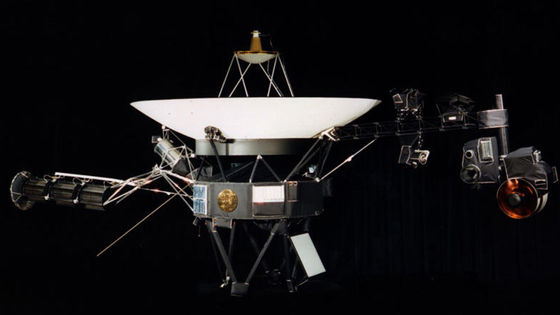
Compared to modern technology, its performance is rather rudimentary, but Voyager 1 has made numerous invaluable discoveries that will go down in scientific history.
For example, during its 1979 Jupiter flyby , Voyager 1 discovered active volcanoes on Jupiter's moon Io. This was the first instance of volcanic activity being observed on a celestial body other than Earth.
In 1980, Voyager 1 approached Titan, Saturn's largest moon, and discovered the presence of a thick nitrogen atmosphere. This confirmed that Titan is the only moon in the solar system with a substantial atmosphere and suggested the existence of hydrocarbon chemistry, which would later be confirmed by the Cassini-Huygens spacecraft.
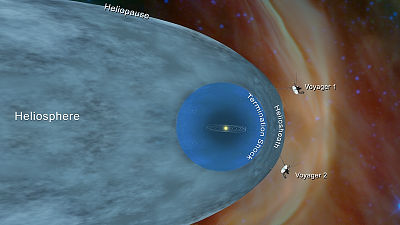
In 2012, it crossed the heliopause , the boundary where the solar wind can no longer react with interstellar matter, becoming the first man-made object to reach interstellar space.
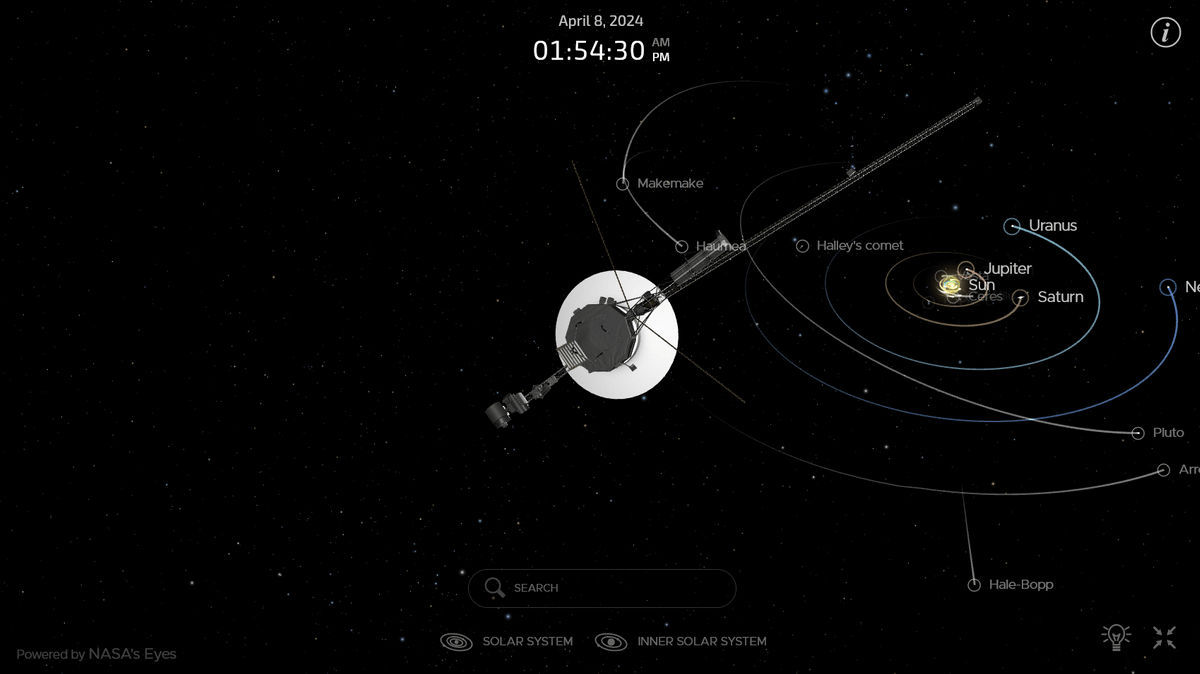
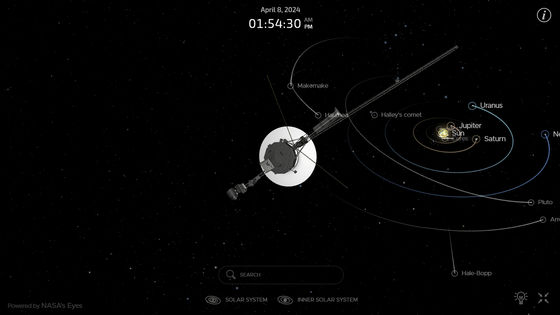
As of 2026, Voyager 1 is traveling at approximately 17 kilometers per second. It is estimated that it will take about 300 years to reach the inner edge of the Oort Cloud , a distant layer of icy celestial bodies that marks the outermost gravitational boundary of the solar system, and about 30,000 years to escape the Oort Cloud, so Voyager 1 has a long journey ahead of it. The onboard radioisotope thermoelectric generator is expected to provide enough power to transmit technical data until 2036. In other words, humans only have about 10 years left to obtain data from Voyager 1.
Related Posts:


in Hardware, Posted by log1p_kr