A new chip inspired by the human brain could potentially significantly reduce the energy consumption of AI.
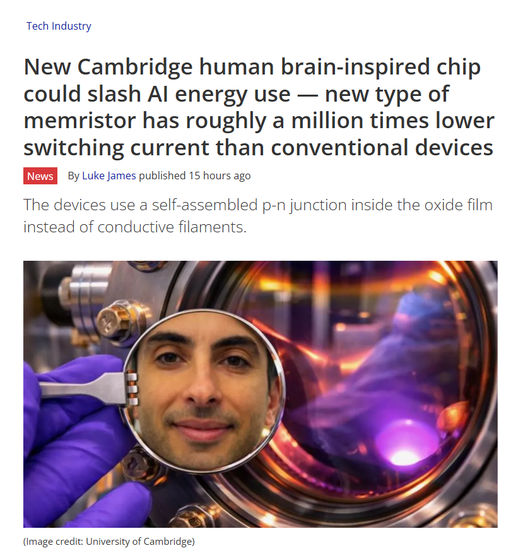
A research team at the University of Cambridge has developed a new chip inspired by the human brain. This chip reduces switching current to about one millionth of that of conventional devices, which, if realized, could drastically reduce the energy consumption of AI.
New Cambridge human brain-inspired chip could slash AI energy use — new type of memristor has roughly a million times lower switching current than conventional devices | Tom's Hardware
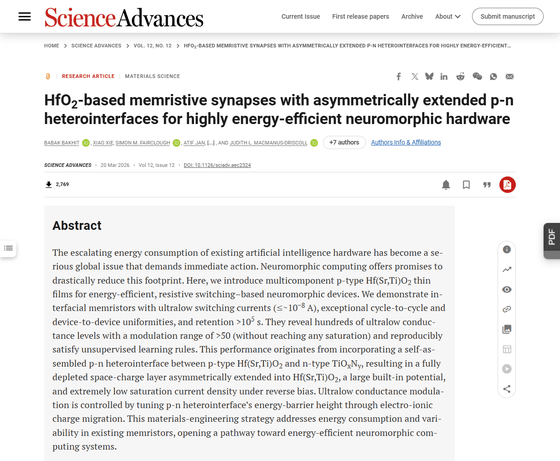
On March 20, 2026, a research team at the University of Cambridge published a paper on hafnium oxide memristors in the scientific journal Science Advances . The most notable feature of this new technology is that the current required to switch the circuit is reduced to approximately one millionth of that required for conventional oxide-based devices.
HfO2-based memristive synapses with asymmetrically extended pn heterointerfaces for highly energy-efficient neuromorphic hardware | Science Advances
https://www.science.org/doi/10.1126/sciadv.aec2324
The hafnium oxide memristor was developed by a research team led by Dr. Babak Bakhit of the Department of Materials Science and Metallurgy at the University of Cambridge. The team developed a multi-component thin film that forms a pn junction , the region where P-type and N-type semiconductor regions meet within a semiconductor, enabling them to smoothly switch the device state with currents of less than 10 nA (nanoamperes) and achieve hundreds of different conductivity levels.
A memristor is a two-terminal device that allows data to be stored and processed in the same physical location. In conventional computer architectures, a large amount of energy is consumed for data transfer between memory units and processing units, but the hafnium oxide memristor developed by the research team eliminates the need for data transfer itself, thus eliminating energy consumption. According to the paper, neuromorphic (neuromimetic) systems built with memristors could potentially reduce computing power consumption by more than 70%.
Most existing hafnium oxide-based memristors rely on filament resistance switching, where conductive paths grow and break within the oxide. Because these filaments exhibit stochastic behavior, they have low uniformity between devices and cycles, limiting computational accuracy.
In response, a research team at the University of Cambridge adopted a novel approach of adding strontium and titanium to hafnium oxide and creating a thin film in a two-step process. This resulted in the formation of a p-type hafnium oxide layer that self-assembles at the pn junction interface with the underlying N-type titanium oxide layer.
Dr. Bacht explains, 'Filamentous devices have the problem of exhibiting random behavior. However, our device performs switching at the interface, so it shows excellent uniformity from cycle to cycle and from device to device.'
Furthermore, the hafnium oxide memristor developed by the research team has demonstrated switching currents of less than 0.00000001 (10 to the power of minus 8 amperes), a hold time exceeding 100,000 seconds, and durability of over 50,000 pulse switching cycles. In addition, by using identical 1V spikes comparable to biological nerve signals, they achieved a modulation range of more than 50 times in electrical conductivity at hundreds of different levels without saturation.
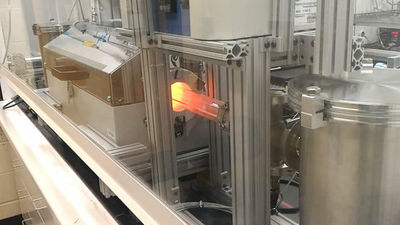
However, existing deposition processes require temperatures of approximately 700 degrees Celsius, which exceeds the tolerances of standard CMOS manufacturing. Therefore, Dr. Bachit stated, 'This is the biggest challenge in the process of manufacturing our devices. However, we are currently working on ways to lower the temperature to fit standard industry processes.' However, all materials used in the device stack are said to be fully compatible with CMOS.
Furthermore, the research team's hafnium oxide memristor has been patented through Cambridge Enterprises .
Related Posts:




in Hardware, Posted by logu_ii