Wine 11 significantly improves speed by rewriting how Linux runs Windows games at the kernel level.

Version 11 of
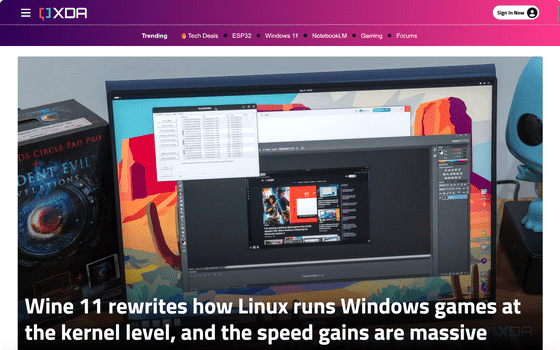
Wine 11 rewrites how Linux runs Windows games at the kernel level, and the speed gains are massive
https://www.xda-developers.com/wine-11-rewrites-linux-runs-windows-games-speed-gains/
Windows games, especially modern games, perform advanced parallel processing, meaning the CPU doesn't handle a single task, but rather simultaneously performs rendering, physics calculations, asset streaming, audio processing, AI processing, and more. These processes constantly need to coordinate with each other, a mechanism in Windows called NT synchronization
These are deeply embedded in the Windows kernel, the core software of Windows, and games rely heavily on this mechanism. The problem is that Linux does not have a mechanism that behaves exactly the same way. Wine has tried to emulate these synchronization mechanisms, but apparently, its method was not ideal.
The original method called a dedicated kernel process called wineserver whenever synchronization between processes was needed. However, for games that make thousands of calls per second, this process becomes a heavy burden, leading to problems such as frame stuttering.

Several workarounds have been developed, but they all merely attempted to replicate Windows' synchronization behavior in Linux, and reportedly did not work correctly in certain cases. This is where NTSYNC comes in.
NTSYNC doesn't try to force Windows synchronization behavior onto existing Linux mechanisms; instead, it directly performs processing modeled after Windows synchronization behavior. This eliminates the need for round trips to the wine server, resulting in the original behavior rather than an approximation.
The results were phenomenal, with developer benchmarks showing the video game 'Dirt 3' improving from 110.6 FPS to 860.7 FPS, an improvement of approximately 678%. 'Resident Evil RE:2' went from 26 FPS to 77 FPS, 'Call of Juarez' from 99.8 FPS to 224.1 FPS, and 'Tiny Tina's Wonderlands' from 130 FPS to 360 FPS.
The biggest beneficiaries of NTSYNC are games that previously struggled with processing, especially titles with high multi-threading loads. Another significant advantage is that, unlike past workarounds, it doesn't require any special patches or settings.

XDA reported, 'This is why NTSYNC is so important. It's not just a performance boost; it's the first time Wine's synchronization process has been properly implemented at the kernel level and made easily accessible to everyone.'
Related Posts: