Workers who prefer nonsensical business terms like 'synergistic leadership' and 'new levels of adaptive consistency' perform less well at their jobs

In the business world, there are a lot of business terms that seem good but are actually unclear, such as 'synergistic leadership' and 'growth hacking paradigm.' A study by
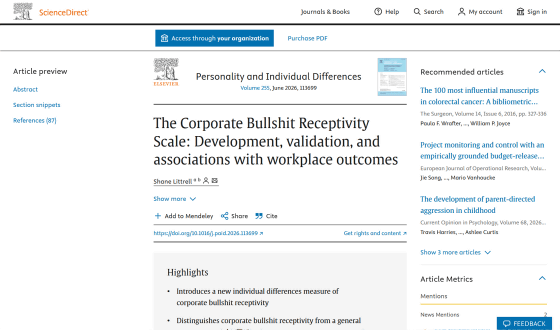
The Corporate Bullshit Receptivity Scale: Development, validation, and associations with workplace outcomes - ScienceDirect
https://www.sciencedirect.com/science/article/abs/pii/S0191886926000620
Workers who love 'synergizing paradigms' might be bad at their jobs | Cornell Chronicle
https://news.cornell.edu/stories/2026/03/workers-who-love-synergizing-paradigms-might-be-bad-their-jobs
While the term 'business jargon' encompasses a wide range of topics, some practical business jargon is useful to users and makes communication more accurate and efficient. However, there is also 'corporate bullshit' that sounds good and impressive but whose true meaning is unclear.
'Business jargon is a specific communication style that uses confusing, abstract buzzwords in a way that is functionally misleading,' says Shane Littrell, a postdoctoral researcher at Cornell University. 'Unlike technical jargon, which can facilitate internal communication somewhat, business jargon confuses rather than enhances understanding. It may sound good, but it is semantically empty.'
It's common for people to use impressive language, even if it's nonsense, to impress others, but problems arise when it's encouraged throughout the company. In a work environment where nonsense business jargon is the norm, ambitious employees may use it to make themselves appear more competent and gain more influence in the workplace.
In this study, Littrell conducted an experiment to examine the relationship between 'sensitivity to nonsense business jargon' and 'skills as a worker.' For the experiment, Littrell created a 'nonsense business jargon generator' and used it to generate a large number of meaningful but memorable sentences, such as 'We will achieve a new level of credentialing from cradle to grave' and 'We will pressure test a new level of adaptive consistency by sharing our best practices with our colleagues.'
In the experiment, we recruited over 1,000 office workers and asked them to read software-generated nonsense business jargon and actual statements made by leaders of Fortune 500 companies, and then asked them to evaluate the business sense of each. We also had them complete existing cognitive tests to examine the relationship between sensitivity to nonsense business jargon and their skills as workers.

The results of the experiment showed that workers who were highly susceptible to business nonsense tended to have lower scores on some skills related to workplace performance, such as analytical thinking, cognitive reflection, and
On the other hand, we also found that workers who are sensitive to nonsense business jargon tend to be more satisfied with their jobs, more sympathetic to their company's mission statement, and more likely to spread it.
The findings suggest that workers who are stimulated by nonsensical business jargon may be less able to make effective decisions for their companies. 'This creates a worrying vicious cycle,' Littrell said. 'Employees who are susceptible to nonsensical business jargon may promote dysfunctional leaders who are susceptible to such abuse, creating a kind of negative feedback loop.'
Furthermore, excessive use of nonsensical business jargon can itself damage a company's reputation. For example, in 2009, Pepsi's marketing materials were found to contain the nonsensical phrase 'The Pepsi DNA finds its origin in the dynamic of perimeter oscillations...' which led to ridicule in various media outlets.
In 2014, a Microsoft executive sent an incredibly long email to employees, which was criticized for being filled with business jargon over 10 paragraphs and finally getting to the point in the 11th paragraph: 'We're laying off 12,500 employees.' This email has also been called the ' worst email ever .'

Littrell believes that measuring sensitivity to business nonsense could one day provide insight into job seekers' analytical thinking and decision-making tendencies.
'Most people are easily fooled by language that sounds sophisticated but isn't, depending on the context,' Littrell said. 'That's why, whether you're an employee or a consumer, when you encounter organizational messaging (whether from a leader, a public report, or an advertisement), it's worth pausing to ask yourself, 'What exactly is this saying? Does it really make sense?' Because when messaging relies on buzzwords and jargon, that's often a warning sign that you're being guided by rhetoric rather than reality.'
Related Posts:








in Science, Posted by log1h_ik