The world's first website can still be found on the internet, but when was it created?
Websites are a part of our everyday lives, but they haven't been around for that long, as evidenced by the fact that the underlying technology,
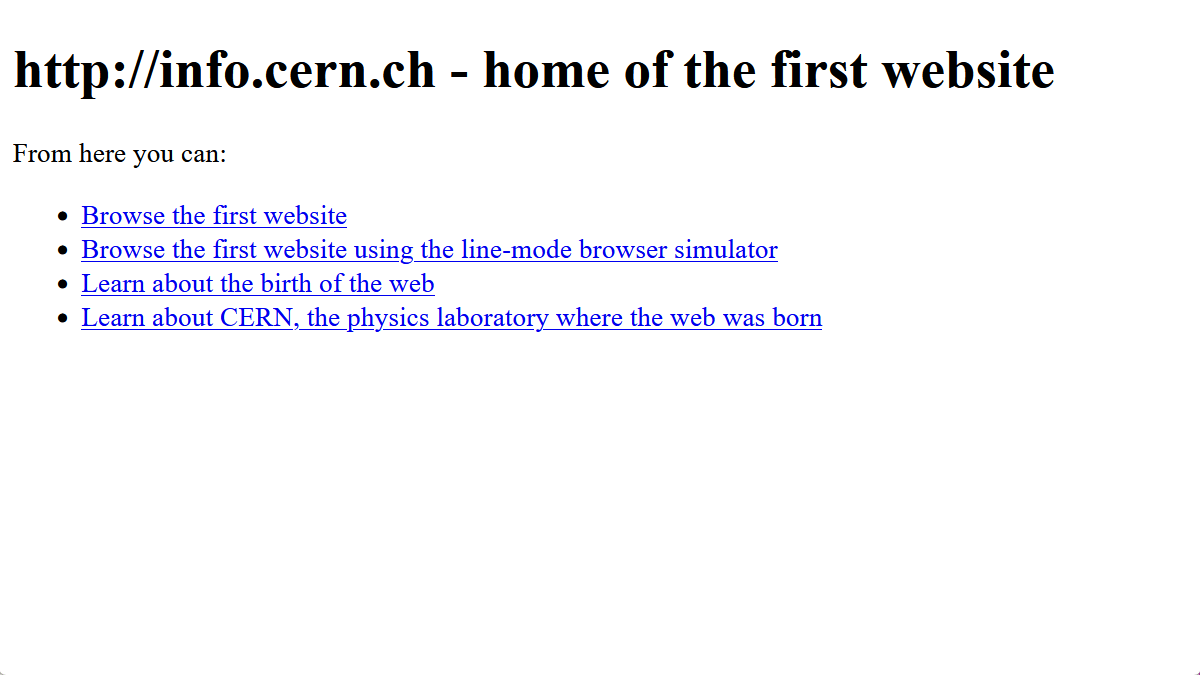
http://info.cern.ch
https://info.cern.ch/
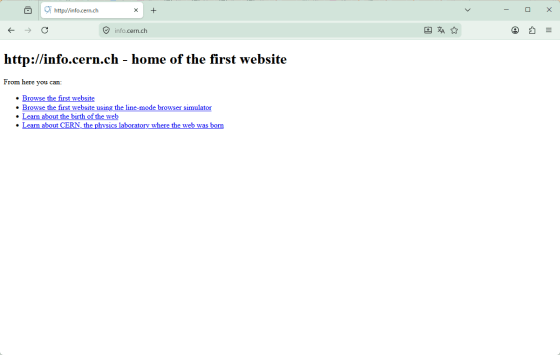
The 'world's first website' was created by Tim Berners-Lee himself while he was at CERN to explain the World Wide Web, and it can still be viewed in your browser at the time of writing. Visiting it will reveal its surprisingly simple structure, but let's take a look at what it looks like at the source code level.
[code]
<html><head></head><body><header>
<title>http://info.cern.ch</title>
</header>
<h1>http://info.cern.ch - home of the first website</h1>
<p>From here you can:</p>
<ul>
<li><a href='http://info.cern.ch/hypertext/WWW/TheProject.html'>Browse the first website</a></li>
<li><a href='http://line-mode.cern.ch/www/hypertext/WWW/TheProject.html'>Browse the first website using the line-mode browser simulator</a></li>
<li><a href='http://home.web.cern.ch/topics/birth-web'>Learn about the birth of the web</a></li>
<li><a href='http://home.web.cern.ch/about'>Learn about CERN, the physics laboratory where the web was born</a></li>
</ul>
</body></html>
[/code]
If you read the source, you'll see the following:
・The <head> tag exists but there is nothing inside it
・There is
- The <header> tag contains the <title> tag
When we hear the <header> tag, we think of it as the tag introduced in HTML5 that defines the header and navigation sections of a page, but prior to HTML 1.0 , when the HTML specifications had not yet been finalized, it was used in a similar way to the current <head> tag, and the code we saw earlier is a remnant of that 'historical usage.'
<header>: The Header element#Historical usage - HTML | MDN
https://developer.mozilla.org/ja/docs/Web/HTML/Reference/Elements/header#%E6%AD%B4%E5%8F%B2%E7%9A%84%E3%81%AA%E4%BD%BF%E7%94%A8%E6%B3%95

If you click on the first of the four links on the top page, ' Browse the first website ,' you will be taken to a page that explains how to use the web page.
The World Wide Web project
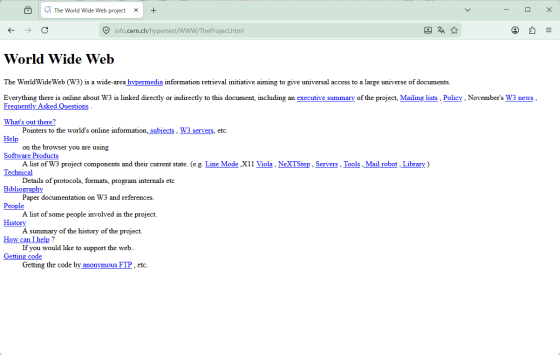
Let's check the source code as before.
[code]
<HEADER>
<TITLE>The World Wide Web project</TITLE>
<NEXTID N='55'>
</HEADER>
<BODY>
<H1>World Wide Web</H1>The WorldWideWeb (W3) is a wide-area<A
NAME=0 HREF='WhatIs.html'>
hypermedia</A> information retrieval
initiative aiming to give universal
access to a large universe of documents.<P>
Everything there is online about
W3 is linked directly or indirectly
to this document, including an <A
NAME=24 HREF='Summary.html'>executive
summary</A> of the project, <A
NAME=29 HREF='Administration/Mailing/Overview.html'>Mailing lists</A>
, <A
NAME=30 HREF='Policy.html'>Policy</A> , November's <A
NAME=34 HREF='News/9211.html'>W3 news</A>,
<A
NAME=41 HREF='FAQ/List.html'>Frequently Asked Questions</A>.
(Omitted below)
[/code]
The code is simple, yet there are many descriptions that give a sense of the era.
・The <html> tag does not exist
・The <head> tag does not exist
・The <header> tag is used instead of the <head> tag
- The
・The <a> tag has a name attribute
The <nextid> tag disappeared quickly, and the name attribute of the <a> tag has been deprecated since HTML5, so it is unlikely to be seen at the time of writing. Also, when compared to the top page, there are inconsistencies in the description, such as the lack of the <html> tag and <head> tag, suggesting that there must have been trial and error in the HTML description.
The ' History ' link is described as 'An overview of the project's history,' so click on it to go there. You may find the answer to the question, 'When exactly was the world's first website created?'
WWW Project History
https://info.cern.ch/hypertext/WWW/History.html
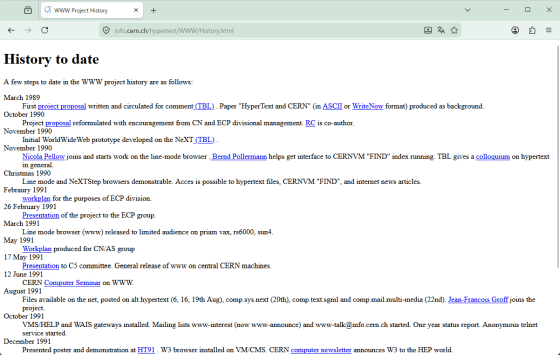
I scrolled down the page and finally found the following:
August 1992
introduction of CVS for code management.
Therefore, this site was finally created in August 1992.
Related Posts:






in Web Service, Design, Posted by log1c_sh