Anthropic reports on trends in occupations susceptible to AI and whether there are changes in the labor market

The rapid spread of AI in recent years has raised concerns that it could lead to an increase in unemployment in jobs that could be replaced by AI and a slowdown in new hiring. Anthropic, the developer of the chat AI Claude, has released a report on the types of jobs that are most susceptible to AI and its impact on the labor market.
Labor market impacts of AI: A new measure and early evidence \ Anthropic
While the spread of AI in recent years has been remarkable, predictions about its impact on the labor market must be evaluated with caution. For example, an attempt to predict the likelihood of jobs being transferred from the United States to overseas positions indicated that approximately 25% of U.S. jobs are at risk of being transferred overseas. However, more than 10 years after this prediction, most of these jobs are still growing at a healthy pace.
To assess the impact of AI on the labor market, Anthropic introduced a metric called 'observed exposure,' which aims to quantify the tasks that can theoretically be accelerated by AI but are actually automated by AI in specialized workplaces.
Factors associated with higher observed exposure include: the task is theoretically capable of being performed by AI; the task has significant application in the Anthropic Economic Index; the task is performed in a work-related context; there is a relatively high proportion of automated usage patterns or API implementations; and tasks influenced by AI make up a significant portion of the overall role.
The pie chart below shows the degree to which AI can accelerate tasks (blue) and the degree of observed exposure (red) for each broad category. Even for tasks that could theoretically be performed by AI, the percentage of tasks actually replaced by AI is not very high. Occupations with particularly high numbers of tasks that could theoretically be performed by AI include 'Management,' 'Business & Finance,' 'Computer & Math,' 'Legal,' 'Arts & Media,' and 'Office & Admin.' The occupations with high observed exposure are similar, but at a much lower percentage.
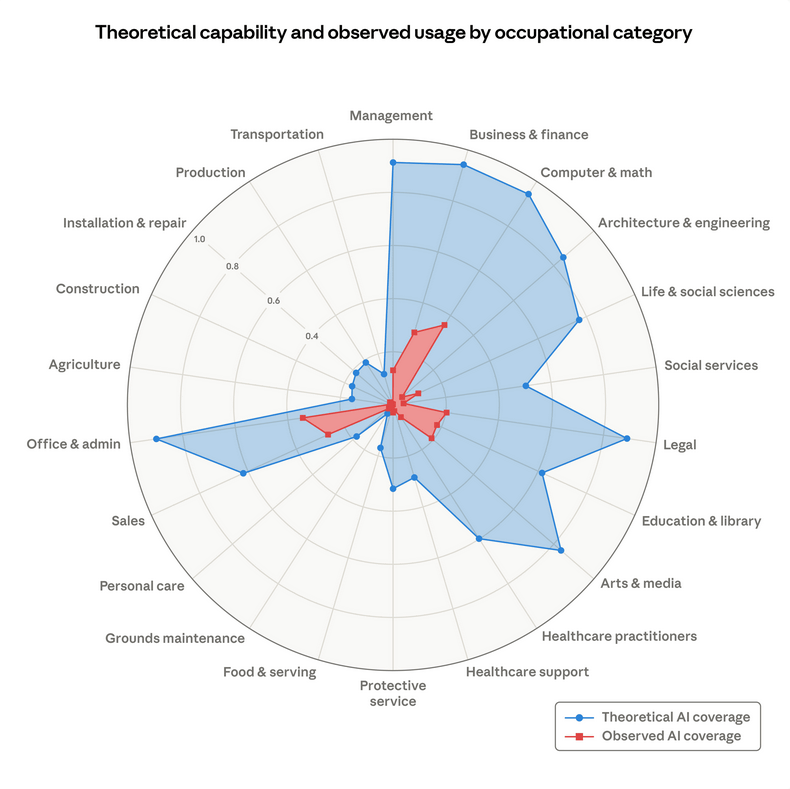
'As AI capabilities evolve, adoption grows, and deployment progresses, the red area will expand to encompass the blue area. However, there remains a large area that is not yet covered. Of course, there are still many tasks that are beyond the reach of AI, from agricultural tasks like trimming trees or operating farm equipment to legal tasks like representing clients in court,' Anthropic said.
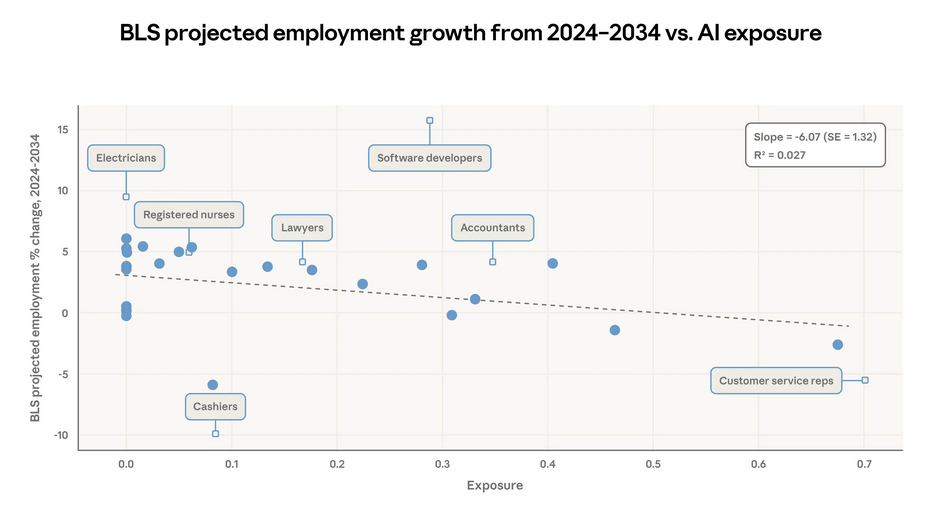
The graph below shows the 'Employment Rate Change by Occupation from 2024 to 2034'
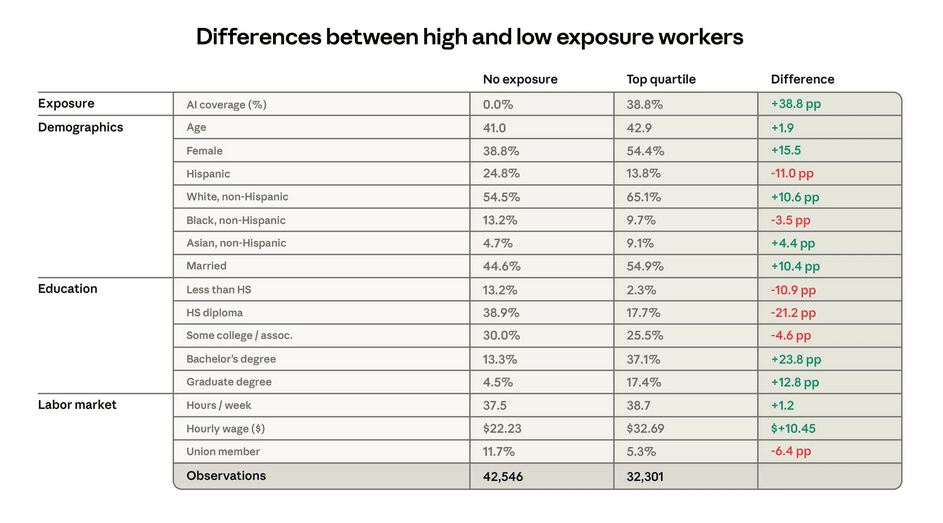
The table below shows the characteristics of the 30% of workers with no observed exposure and the top 25% of workers with the most observed exposure. The high-exposure group is approximately 16 percentage points more likely to be female, 11 percentage points more likely to be white, and 4.4 percentage points more likely to be Asian (almost double the average). They also tend to have a 47% higher average income and significantly higher levels of education.
On the other hand, the differences in observed exposures have been shown to barely translate into differences in unemployment rates at the time of writing. The top graph below shows the top 25% of those with the most observed exposures (red) and the 30% with no observed exposures (blue), with the vertical axis representing unemployment rate and the horizontal axis representing age. While there is a gap between the two groups, there is no difference in trends before and after the release of ChatGPT in 2023. The bottom graph shows the difference in unemployment rates between the two groups, again revealing no apparent impact from the release of ChatGPT.
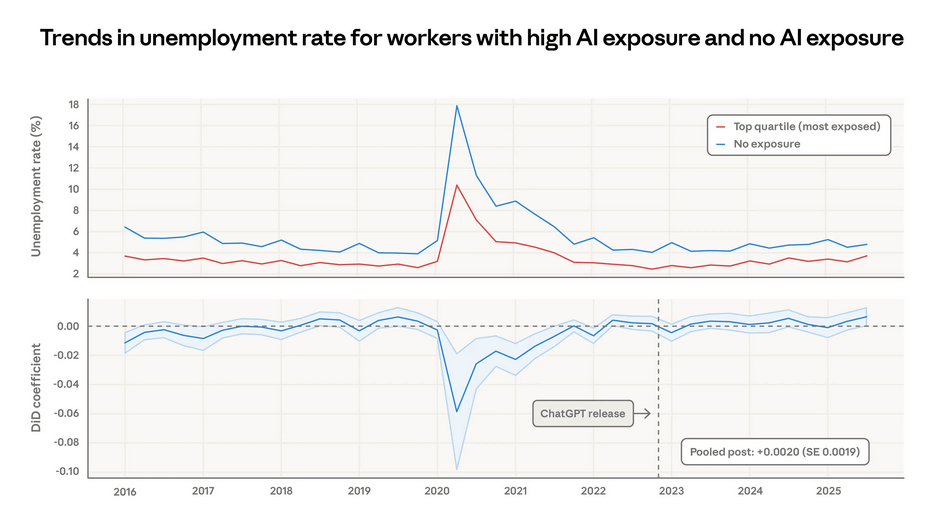
In contrast, the proportion of young workers aged 22 to 25 working in the observed high-exposure occupations is declining slightly, which may signal an early impact of AI on employment.
Anthropic said, 'Occupations with a high AI impact are those where the tasks are theoretically feasible using large-scale language models and where we have observed automated work-related use cases on our platform. We found that computer programmers, customer service representatives, and financial analysts have the highest exposure to AI. Using US survey data, we found no impact on unemployment rates for workers in occupations with the highest AI exposure, although there is preliminary evidence of a slight slowdown in employment of 22- to 25-year-olds in these occupations.'
Related Posts:








in AI, Posted by log1h_ik