California introduces age verification law for operating systems, including Linux and SteamOS

The California
California introduces age verification law for all operating systems, including Linux and SteamOS — user age verified during OS account setup | Tom's Hardware
https://www.tomshardware.com/software/operating-systems/california-introduces-age-verification-law

The California Digital Age Assurance Act, signed by Governor Gavin Newsom in October 2025, requires companies offering online services and products that children may access to comply with certain requirements, including the ability to reasonably determine whether a user is a child and to apply a high standard of privacy protection to all consumers, based on child standards. It also prohibits services and products from using dark patterns to induce users to provide more personal information than would reasonably be expected or to waive privacy protections.
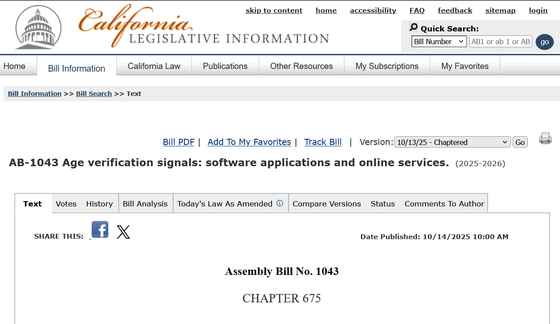
Specifically, the Digital Age Guarantee Act requires OS providers to collect users' ages and categorize them into four categories: 'under 13,' '13-16,' '16-18,' and '18 and over,' in order to limit the services and apps that children can control. When an app is downloaded or launched on the OS, the OS must pass a signal about the user's classification to the app developer.
Developers who receive this signal are considered to have 'known the age group of their users' and are liable for age-inappropriate content, up to $2,500 for each child affected for negligent violations and up to $7,500 for intentional violations.
The law broadly defines 'OS provider' as 'any person that develops, licenses, or maintains operating system software for computers, mobile devices, or other general-purpose computing devices,' which may include not only PC and smartphone operating systems such as Windows, macOS, Android, and iOS, but also Linux distributions and Valve's SteamOS. However, some Linux distributions are open source, meaning the source code can be freely modified and the operating system is not maintained by a company, making it difficult to apply the provisions of the Digital Age Guarantee Act.
The Digital Age Assurance Act is scheduled to come into effect on January 1, 2027, but Governor Newsom, who signed the bill, expressed concern that 'complexity, such as multiple user accounts shared by family members and user profiles used on multiple devices, could place a heavy burden on streaming services and game developers,' and issued a statement urging Congress to amend the law before it comes into effect. Furthermore, because the Digital Age Assurance Act does not require the uploading of photo ID or facial recognition, it is considered that there may be issues with its effectiveness compared to the strict age verification measures adopted in other states and the EU for the purpose of protecting minors.
Related Posts:








in Software, Web Service, Posted by log1e_dh