Poor sleep may negatively affect the intestines and increase the risk of ulcerative colitis and Crohn's disease

It is known that lack of sleep not only causes daytime drowsiness and sleepiness, but also has various adverse effects on the mind and body. A new paper published by a team led by Chinese researchers reports that sleep deprivation may have a negative effect on the intestines via
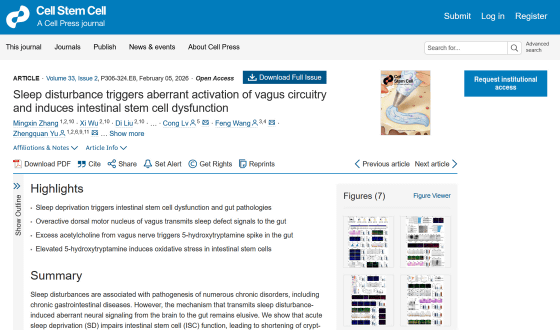
Sleep disturbance triggers aberrant activation of vagus circuitry and induces intestinal stem cell dysfunction: Cell Stem Cell
https://www.cell.com/cell-stem-cell/fulltext/S1934-5909(26)00025-1
Sleep deprivation triggers a cascade of harmful signals from the brain to the gut | Live Science
https://www.livescience.com/health/sleep/sleep-deprivation-harms-the-gut-via-the-vagus-nerve-early-study-reveals
It is said that approximately 10% of adults worldwide suffer from insomnia , and chronic sleep disorders not only interfere with daily life but are also associated with an increased incidence of chronic diseases such as IBD, diabetes, hypertension, and depression.
In particular, more than 75% of IBD patients report experiencing sleep disturbances, and a study of more than 1,200 IBD patients in remission showed that IBD patients with sleep disturbances were twice as likely to relapse. However, because most research on sleep disturbances has focused on the brain, the effects of sleep deprivation on organs such as the gut are poorly understood.
To clarify the effects of sleep deprivation on the intestines, a research team from Zhengzhou University and China Agricultural University in China conducted experiments focusing on intestinal stem cells in mice. Intestinal stem cells play an important role in maintaining the integrity of the intestinal lining and maintaining intestinal health.

The research team conducted an experiment in which mice were sleep-deprived for 48 hours to examine changes in intestinal condition and stem cells.
The results of the experiment confirmed that sleep-deprived mice showed signs of oxidative stress in the intestines, the number of intestinal stem cells in these mice was approximately half that of mice with sufficient sleep, and their ability to recover from radiation-induced stem cell damage was significantly reduced.
'This study demonstrates that sleep disruption can rapidly and severely damage the gut,' study co-author Chengchuan Yu, a molecular biologist at China Agricultural University, told Live Science.
The research team then looked more closely at the molecular changes occurring in the intestines and found that sleep deprivation was associated with increased levels of
It was found that sleep deprivation not only caused excessive secretion of serotonin from intestinal cells in mice, but also reduced reuptake of serotonin, leading to its accumulation in the intestine. When serotonin was injected into the intestines of mice that had had enough sleep, changes similar to those caused by sleep deprivation were observed.
The research team hypothesized that the adverse effects of sleep deprivation on the gut are mediated by the vagus nerve, which connects the brain and gut. They investigated the effects of sleep deprivation in mice in which the vagus nerve had been severed. The results showed that compared to normal mice, vagus nerve-severed mice maintained near-normal serotonin levels and a higher number of intestinal stem cells, even when sleep-deprived. They also found that blocking signals from the vagus nerve also reduced the intestinal effects of sleep deprivation, and that acetylcholine is the primary signaling molecule that triggers serotonin release.

'This study was conducted in mice, and further research is needed to determine whether the same phenomenon occurs in humans. However, if we can determine that a similar pathway by which sleep disorders affect the gut also exists in humans, this could lead to the development of potential therapeutic targets and treatments.'
The research team plans to investigate the relationship between the gut and the vagus nerve in chronic sleep disorders and to determine whether long-term activation of the vagus nerve contributes to the development of IBD and cancer.
Related Posts:








in Free Member, Science, Posted by log1h_ik