Successfully achieves 'super-lubricity' on a macroscopic scale, where friction between two surfaces is virtually zero
When two solid surfaces come into contact with each other,
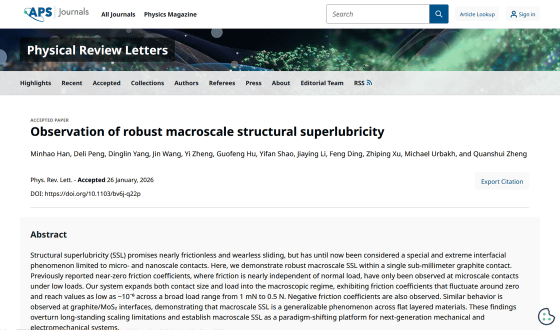
Physical Review Letters - Accepted Paper: Observation of robust macroscale structural superlubricity
https://journals.aps.org/prl/accepted/10.1103/bv6j-q22p
Physicists achieve near-zero friction on macroscopic scales
https://phys.org/news/2026-02-physicists-friction-macroscopic-scales.html
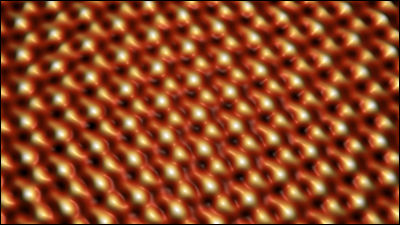
When two objects touch or rub against each other, friction inevitably occurs due to the roughness of their surfaces, but in 2004, researchers showed that by rotating the molecular structure of two graphite surfaces, friction could be virtually eliminated.
Structural superlubricity eliminates friction when materials rub against each other, reducing energy loss as waste heat and reducing wear on mechanical parts. For this reason, the realization of structural superlubricity has been eagerly anticipated in the field of engineering, but for a long time, structural superlubricity had only been confirmed on a scale invisible to the naked eye.
The reasons for the difficulty in achieving structural superlubricity on a macroscopic scale include the elasticity of the object surface, defects in the molecular structure, and the fact that the surface of actual graphite does not have a single-crystal structure.
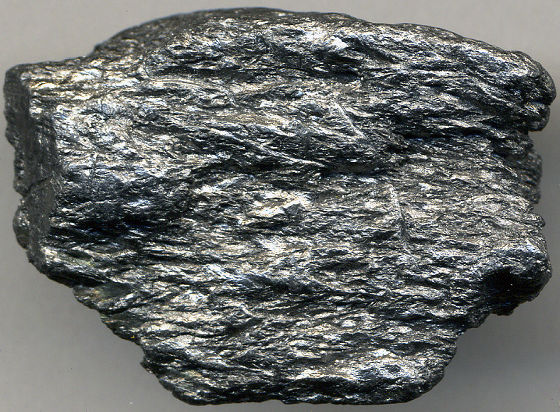
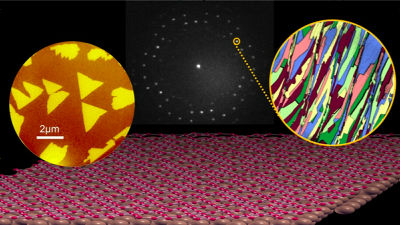
The surface of graphite is divided into tiny particles, and although each particle has an ordered structure, the relative orientation of the particles is random. Because the size of individual particles is limited to a few tens of micrometers, it is difficult to observe structural superlubrication at larger scales.
by James St. John
Now, a research team led by Guangshui Chen, a professor of engineering at Tsinghua University in China, has tackled this problem by growing single-crystal graphite films containing millimeter-sized particles using a technique called sequential epitaxy .
By combining sequential epitaxy with careful layering techniques, the research team was able to more precisely control the orientation of the graphite film. 'This approach enabled us to build a nearly defect-free interface at a sub-millimeter scale that maintains intimate atomic contact in the macroscale domain,' said co-author Deli Peng. 'As a result, we were able to overcome the scaling barriers that limited previous experimental systems for observing structural superlubrication.'
As a result of their experiments, the research team was able to observe structural superlubricity at the macroscopic scale for the first time. In this structural superlubricity state, friction remains essentially zero even when various weights are placed on the surface, and in some cases, they even observed 'negative friction,' where resistance decreases as the load increases.
Under the most extreme conditions the research team envisioned, they estimate that even an 'adult elephant' standing on the surface could be moved by the weight of two eggs, or by a gentle breeze.
Related Posts:

in Science, Posted by log1h_ik