Combining small improvements in sleep, exercise, and diet could significantly extend lifespan and health.

Sleep, exercise, and diet are often discussed individually as factors related to health, but in real life, they affect each other in ways such as 'if I can't sleep, my eating habits will be affected' or 'I'm too sleepy to exercise for days in a row.' A research team at the University of Sydney in Australia used data from UK Biobank to estimate how much life expectancy and healthspan could be extended by gradually improving the three factors of sleep, physical activity, and diet together. The results showed that the effects could be greater than the sum of the three factors.
Minimum combined sleep, physical activity, and nutrition variations associated with lifeSPAN and healthSPAN improvements: a population cohort study - eClinicalMedicine
Tiny improvements in sleep, nutrition and exercise could significantly extend lifespan, study suggests | Live Science
https://www.livescience.com/health/tiny-improvements-in-sleep-nutrition-and-exercise-could-significantly-extend-lifespan-study-suggests
The research team, led by Nicholas Cormel and Emmanuel Stamatakis, registered dietitians at the University of Sydney's Charles Perkins Centre, focused on three factors: sleep duration, MVPA (moderate-intensity physical activity such as brisk walking or stair climbing), and a diet quality score (Diet Quality Score). Sleep and physical activity were measured by participants wearing wristbands with accelerometers for seven days, and diet quality was scored using a questionnaire.
The research team linked these factors with follow-up data from approximately 59,000 people in the UK Biobank, a data base for large-scale long-term follow-up studies conducted in the UK, to estimate how much life expectancy and healthspan change for each combination of lifestyle habits.
The key point of this study is that it treated the three factors as a 'combination' rather than 'separately.' The research team divided sleep, moderate-intensity exercise, and dietary quality into low, medium, and high ranges and compared 27 combinations. They found that the combination of 'seven to eight hours of sleep, frequent moderate-intensity exercise, and high-quality diet' tended to have the greatest increase in lifespan and healthy lifespan.
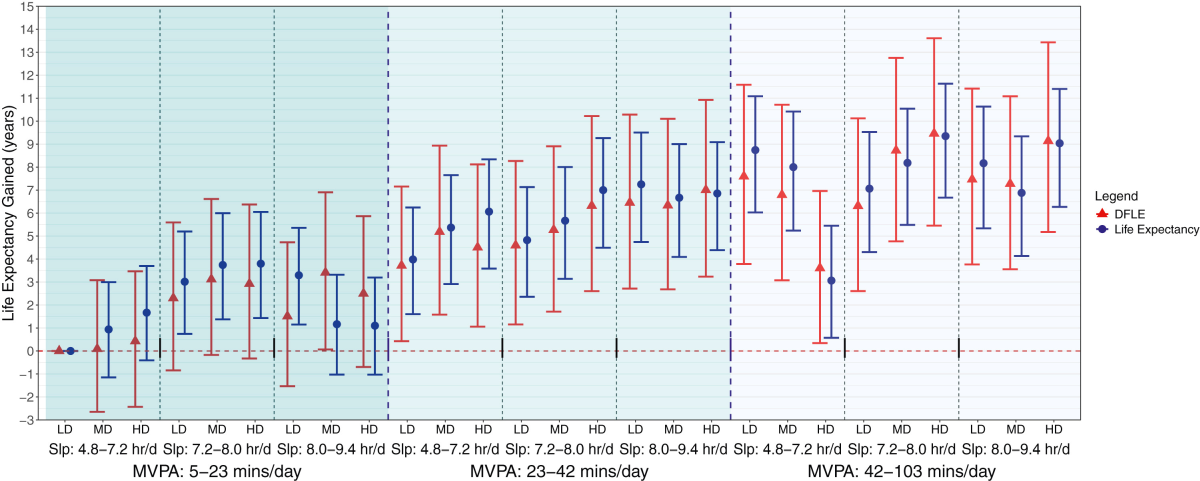
'Small changes in multiple behaviors combined can make more than the sum of their parts,' Cormel said. For example, the idea is that if you want to boost your lifespan by one year through sleep alone, you'll need a larger increase in sleep, but if you also make small improvements to exercise and diet quality, you'll need less.
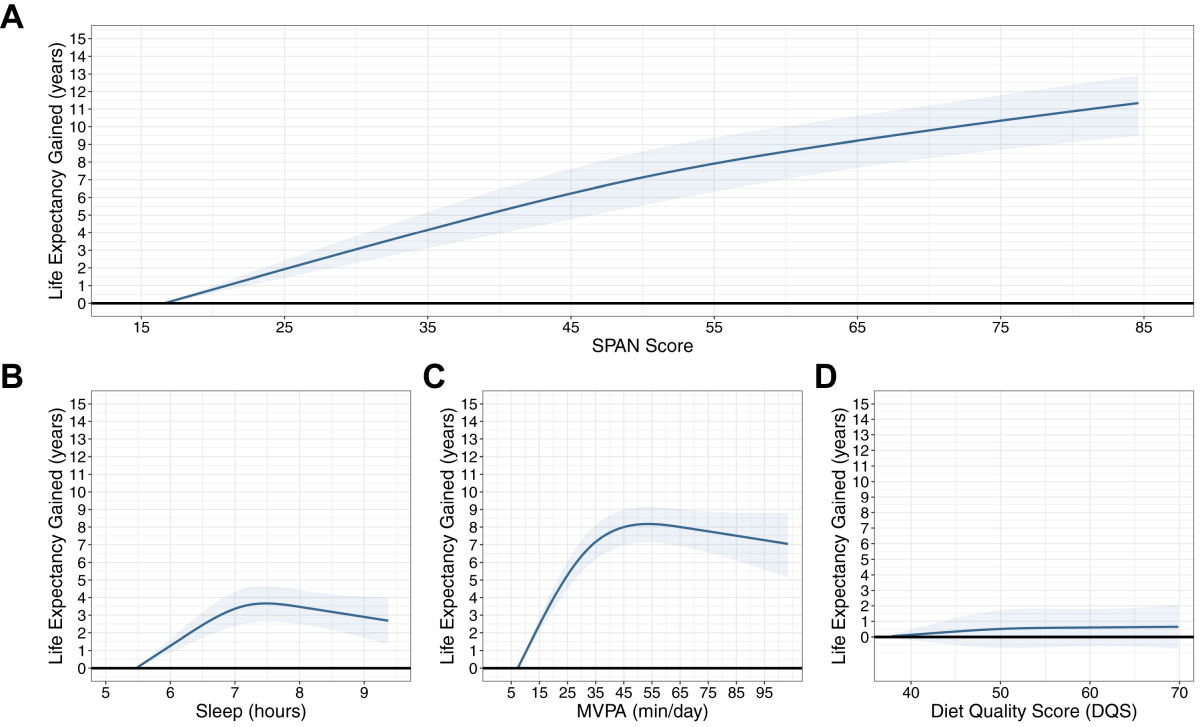
Graph A below shows the relationship between 'SPAN Score' and 'the number of years of life expectancy that could be added.' The horizontal axis, 'SPAN Score,' is a comprehensive lifestyle index that combines sleep, moderate-intensity physical activity (MVPA), and dietary quality (DQS), and is expressed on a scale from 0 to 100. All three factors are weighted equally, with higher scores indicating a more desirable state. Because both too little and too much sleep can increase risk, the research team explains that the score was scaled so that the lowest correlation with mortality risk was around 7.5 hours. Graphs B, C, and D show the relationship between sleep time, MVPA, and dietary quality and 'the number of years of life expectancy that could be added.' The horizontal axis of Graph B represents sleep time, the horizontal axis of Graph C represents MVPA, and the horizontal axis of Graph D represents dietary quality. The vertical axis of all graphs represents 'the number of years of life expectancy that could be added.'
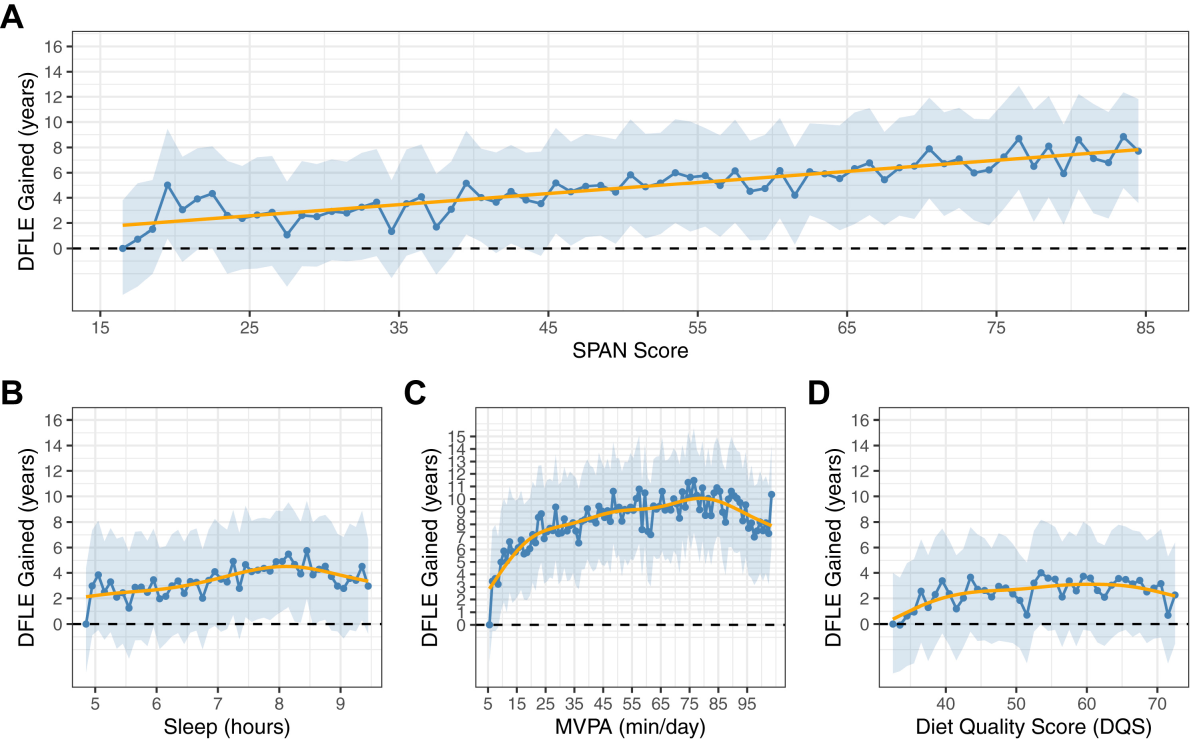
Considering the difficulty of suddenly making major changes to the quality of sleep, exercise, and diet, the research team estimated how much a healthy lifespan free from chronic disease could be extended by making 'very small' improvements to all three factors simultaneously. Based on the results, the research team explained that for people with particularly poor lifestyle habits (those with low levels of sleep, moderate-intensity exercise, and dietary quality), even a 'set of small improvements'—increasing sleep by five minutes per day, increasing moderate-intensity exercise by about two minutes, and slightly improving dietary quality (e.g., by increasing vegetables)—could potentially extend healthy lifespan by about one year.
The graph below shows the relationship between SPAN Score, sleep, MVPA, and dietary quality indicators and the 'extension of healthy life expectancy.' The horizontal axis of the graph shows each indicator, and the vertical axis shows the 'number of years that healthy life expectancy could potentially be extended.'
However, this study did not actually have participants change their sleep, exercise, or diet and measure the effects, but rather used a statistical model to estimate whether people with better lifestyle habits tend to have longer and healthier lifespans based on UK Biobank data. Therefore, even if differences were observed, it cannot be concluded that improvements in lifestyle habits were the direct cause.
Regarding this study, the science media Live Science pointed out that 'sleep and exercise were measured over a period of around seven days,' 'dietary intake was assessed at a specific time point and did not track long-term changes,' and 'unmeasured factors (such as income or living environment) may have influenced the results.' Stephen Burgess, a statistician at the University of Cambridge, commented that 'this study alone cannot prove causation.'
Still, the idea of first making small improvements to improve sleep, exercise, and diet all at once may be an approach that many people can easily adopt. The research team concluded that this could lead to guidelines that incorporate the idea of improving the three elements as a set, rather than discussing them separately, and concluded that additional research is needed to determine how this can be used in clinical and public health settings.
Related Posts:








in Science, Posted by log1b_ok