Research results are published on how 'likes' became private on X (formerly Twitter) and what impact it had

In May 2024, X (formerly Twitter) made its 'likes' section private. A research paper examining the impact of this change has been published on the preprint server arXiv.
[2601.11140] When 'Likers'' Go Private: Engagement With Reputationally Risky Content on X
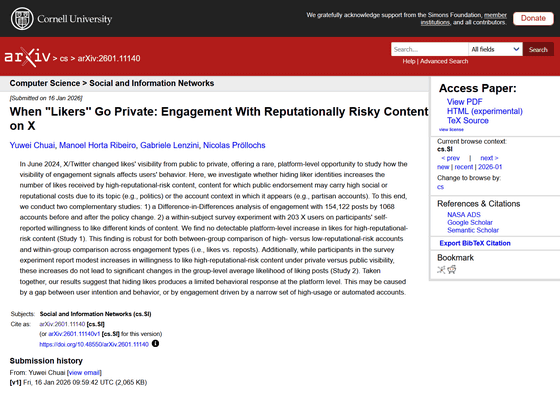
When “Likers” Go Private: Engagement With Reputationally Risky Content on X
https://arxiv.org/html/2601.11140v1
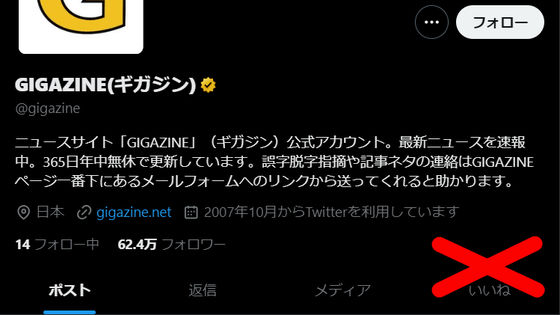
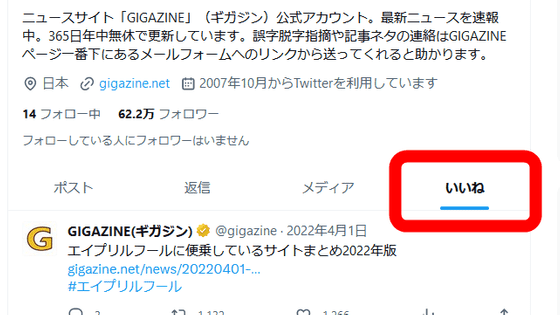
In May 2024, X suddenly changed its specifications, which allowed anyone to freely check other users' 'like' columns, and made the 'like' columns of other users' accounts invisible. Regarding the reason for this, X's engineering director explained, 'We are making likes private because making the like column public encourages wrong behavior. For example, many people hesitate to like potentially 'extreme' content for fear of retaliation from trolls or to protect their own image. Therefore, we will soon make it possible to 'like' without worrying about who is looking.'
X (formerly Twitter) has made the 'Like' section private, as allowing anyone to see what you 'liked' encourages bad behavior - GIGAZINE
So, a research team led by Yuwei Chuai , who studies social networks and misinformation at the University of Luxembourg, investigated how making the 'like' column private affects user engagement .
For example, making the 'like' section private made it easier to 'like' content that could affect one's reputation, such as sexual content or political posts. Therefore, Chuai and his team investigated whether the number of 'likes' for content that could potentially incur social or reputational costs (content that could potentially damage one's reputation by liking: high-reputation risk content) increased after X's 'like' section was made private.
First, the researchers looked at engagement on 154,122 posts from 1,068 accounts before and after the 'like' section was made private. Then, they asked 203 X users to self-report their willingness to 'like' different types of content.
A survey of 203 X users found that users were slightly more willing to like high reputation risk content when the likes section was private.
However, when we looked at the likes on actual posts, we found no conclusive evidence that the number of likes for high reputation risk content increased across platforms. Furthermore, regardless of the nature of the content (high reputation risk or not) or the type of engagement (likes vs. reposts), there was no change in engagement for high reputation risk content when the likes section was made private.

Based on these results, the research team concluded that the impact of making the 'likes' section private on X as a whole was likely very limited. In addition, the research team pointed out that engagement on X may be generated by a small number of high-frequency accounts or automated accounts.
Related Posts:



in Web Service, Science, Posted by logu_ii