'Oldest poison arrow' discovered: 60,000-year-old arrow contains traces of natural poison

Traces of poison have been found on the tips of arrows discovered at archaeological sites in South Africa. This is the first direct evidence that people used poison on the tips of hunting weapons during the Pleistocene epoch 60,000 years ago.
Direct evidence for poison use on microlithic arrowheads in Southern Africa at 60,000 years ago | Science Advances
World's oldest arrow poison – 60,000-year-old traces reveal early advanced hunting techniques - Stockholms universityt
https://www.su.se/english/news/articles/2026-01-08-worlds-oldest-arrow-poison---60000-year-old-traces-reveal-early-advanced-hunting-techniques
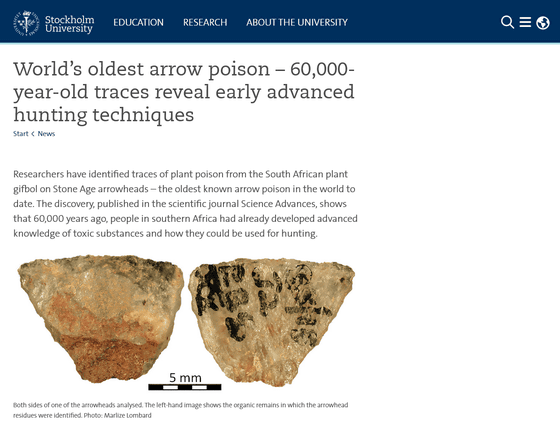
Arrow tips found in South Africa are the oldest evidence of poison use in hunting
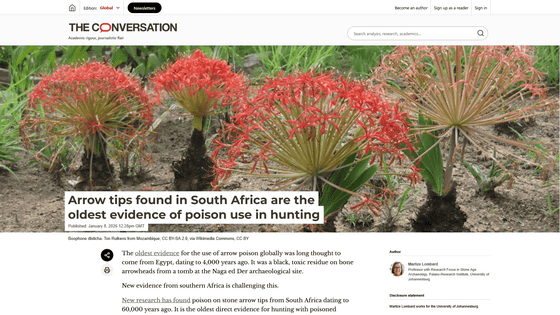
An international research team from Stockholm University in Sweden and the University of Johannesburg in South Africa analyzed a 60,000-year-old quartz
The oldest known example of a poisoned arrow dates back 6,700 years, and Professor Marlies Lombard of the University of Johannesburg's Paleoinstitute said, 'This discovery is the oldest direct evidence of human use of poisoned arrows. It not only shows that our ancestors in South Africa were using bows and arrows much earlier than previously thought, but also that they understood how to use natural chemicals to improve hunting efficiency.'
A photograph of the arrowhead taken by Professor Lombard.
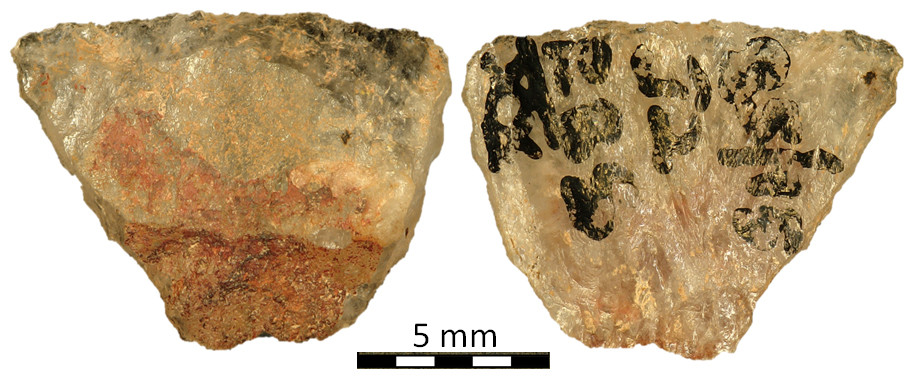
A similar poison was also found in a 250-year-old arrowhead acquired by an 18th-century traveller. Professor Sven Isaksson of Stockholm University commented on the discovery, saying, 'It is groundbreaking to find traces of the same poison in prehistoric and historic times.' He added, 'It is also interesting that people had such a deep and long-lasting knowledge of the uses of plants.'
Related Posts:



in Free Member, Science, Posted by logc_nt