Google summarizes its research and development for 2025, highlighting its wisdom in a wide range of fields, including AI, medicine, science, computing, and creativity.
Google describes 2025 as 'If 2024 was the year we laid the foundation for multimodal AI , 2025 was the year AI truly began to think, act, and explore the world with us.' Google's progress in research and development in 2025 was explained by Jeff Dean , Senior Fellow for Google Research and AI, Demis Hassabis , CEO of Google DeepMind, and James Manica, Senior Vice President of Research, Technology, and Society.
Google 2025 recap: Research breakthroughs of the year
https://blog.google/technology/ai/2025-research-breakthroughs/
◆Achieving groundbreaking results with world-class AI models
Google will release Gemini 2.5 as its next-generation AI model in March 2025.
Google announces next-generation inference AI model 'Gemini 2.5', significantly improving inference and coding performance - GIGAZINE
In addition, in November, the company announced Gemini 3, which has performance far exceeding that of competing AI models.
Finally, 'Gemini 3' is here, it's free to use and has better performance than GPT-5.1 and Grok 4.1 - GIGAZINE
In December, we released Gemini 3 Flash, the latest model in the Gemini 3 family, which focuses on speed and efficiency.
Google releases Gemini 3 Flash, maintaining the advanced inference capabilities of Gemini 3 Pro while being faster and about a quarter the price - GIGAZINE

Regarding Gemini 3 Pro, the higher-end model of Gemini 3, Google states, 'Built on cutting-edge inference technology, Gemini 3 Pro is the most powerful AI model ever, designed to help you bring any idea to life. It topped the LMArena leaderboard and achieved groundbreaking scores in benchmarks like Humanity's Last Exam (a highly challenging test that tests whether an AI model can truly think and reason like a human) and GPQA Diamond , redefining multimodal inference. It also achieved the highest score of 23.4% on MathArena Apex , setting a new standard for frontier models in mathematics.'
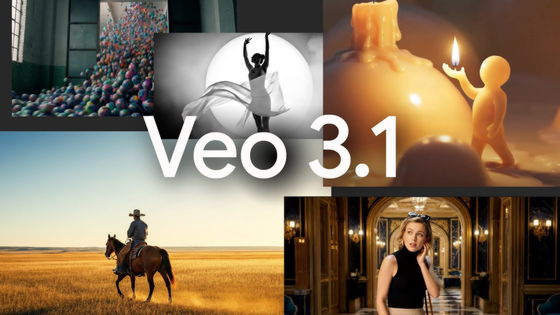
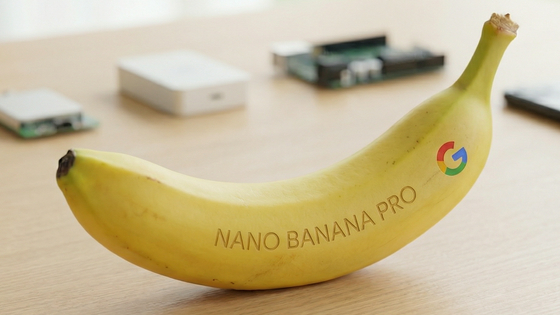
In addition to inference models, Google has also announced AI such as the video generation AI Veo 3.1 and the image generation AI Gemini 3 Pro Image (Nano Banana Pro).
Google releases video generation AI 'Veo 3.1,' supporting video generation of over 1 minute and improved audio quality - GIGAZINE
In addition, Google has released Gemma 3, an open-source model that can also be used commercially, to make useful AI technology available to everyone.
Google announces 'Gemma 3,' the largest language model ever to run on a single GPU - GIGAZINE
In addition, Google has also released 'Gemma 3 270M' as a small, high-performance AI model that can run on low-spec devices such as smartphones.
Google releases Gemma 3 270M, a small, high-performance AI model that can run on low-spec devices such as smartphones, and has excellent power-saving performance and can be used as a base model for AI specialized in specific fields - GIGAZINE
◆ AI-driven product innovation and transformation
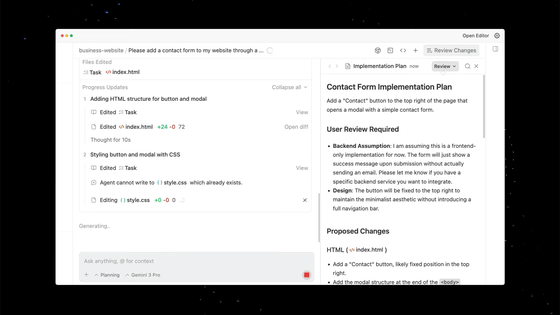
Throughout 2025, Google continues to evolve AI from a tool to a utility, expanding its product portfolio with powerful agent capabilities. Beyond just a coding tool, Google is reimagining software development by introducing powerful agent systems that collaborate with developers. Important advancements like the powerful coding capabilities of Gemini 3 and the release of Google Antigravity represent a new era of AI-powered software development.
Google launches Gemini 3 Pro and agent-first coding tool 'Google Antigravity' for Windows, macOS, and Linux as a free public preview.
This evolution is evident across Google's core products, including the AI features in the Pixel 10, AI mode in Google Search, and Gemini's Deep Research.
Google's search AI 'Deep Research' is now available for free, and 'Gems' to customize Gemini for yourself is also free - GIGAZINE
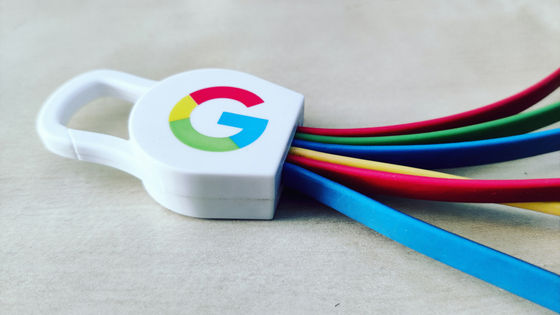
Google Search's 'AI mode' will be available in Japanese - GIGAZINE

◆Enhancing creativity and co-creation using AI
Google describes 2025 as a 'transformative year for generative media.' Generative media models and tools for video, images, audio, and worlds will become more effective and widely available, and groundbreaking tools Nano Banana and Nano Banana Pro will offer unprecedented capabilities in native image generation and editing.
Google is working with the creative industry to develop tools like Flow and the Music AI Sandbox to better support creative workflows, and is 'expanding what people can create' with new AI-powered experiences in Google Arts & Culture, a major upgrade to image editing in the Gemini app, and the introduction of powerful generative media models like Veo 3.1, Imagen 4, and Flow.
Google announces image generation AI 'Imagen 4', capable of generating images up to 2K and a high-speed version 10 times faster than Imagen 3 is also planned - GIGAZINE



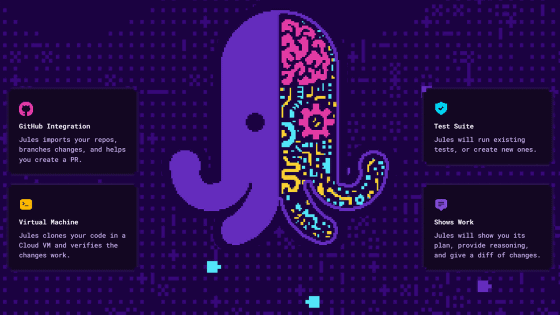
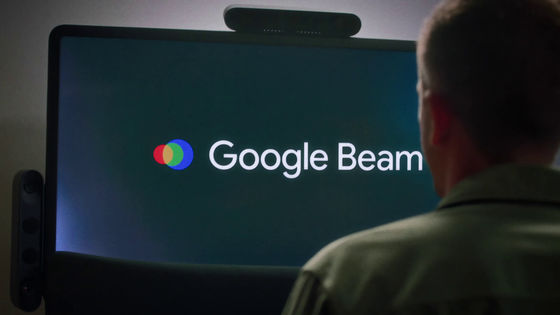
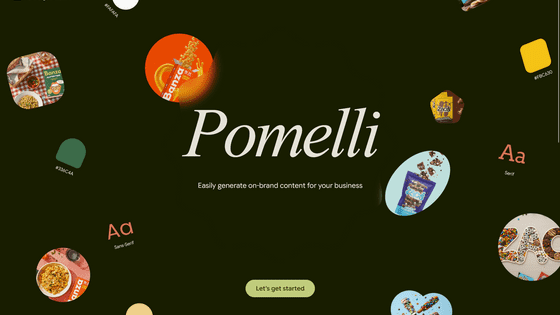
Google is also developing Google Labs, a testing ground for general users to experience new technologies and AI functions in advance. Projects that are attracting attention from Google Labs in 2025 include Jules, a coding assistant AI; Stitch, a tool for designing complex UIs based on simple prompts and images; Google Beam, a next-generation 3D video communication platform; and Pomelli, an AI for automatically generating advertising images.
Google's coding agent AI 'Jules' public beta version released, powerful coding with Gemini 2.5 Pro - GIGAZINE
Google launches Pomelli, an AI that automatically generates advertising images - GIGAZINE
Advances in science and mathematics
In just one year, Google has made great strides in building AI resources and tools to support researchers and help healthcare understand, identify, and develop treatments. After a decade of applying cutting-edge technologies to research, the field of genomics has moved beyond sequencing, enabling AI to interpret the most complex data. We also celebrated the fifth anniversary of AlphaFold, the Nobel Prize-winning AI system that solved the 50-year-old protein folding problem. AlphaFold is used by more than 3 million researchers in over 190 countries, including more than 1 million users in low- and middle-income countries.
The impact that Google has had on medical science through the use of AI is as follows:
Google's evolutionary AI 'AlphaEvolve' can discover unknown algorithms and new solutions to unsolved mathematical problems, and is already being used internally by Google to improve the efficiency of AI development and chip design - GIGAZINE
In the field of mathematics, an enhanced version of 'Gemini Deep Think' competed in the International Mathematical Olympiad and achieved a score equivalent to a gold medal.
Google's enhanced Gemini reaches the gold medal performance at the Mathematical Olympiad, works in natural language, and derives answers within the same time limit as humans - GIGAZINE
Innovation in Computing and the Physical World
Google has also led important discoveries in the areas of quantum computing, energy, and moonshots. Google's work in space infrastructure and quantum computing includes:
Google Chief Scientist Michel Devoret, former Googler John Martinis, and John Clarke win Nobel Prize in Physics for quantum computing research - GIGAZINE
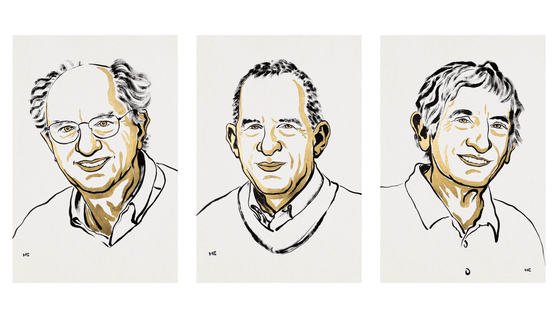
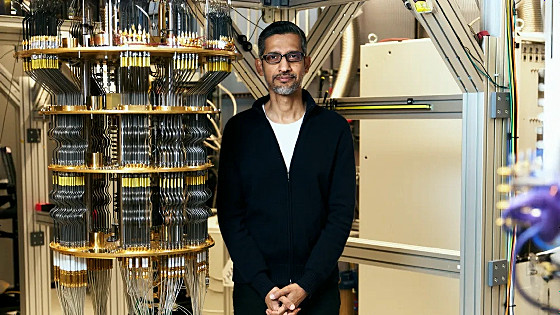
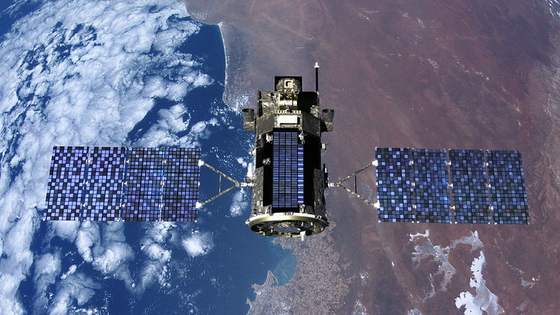
by NASA Goddard Space Flight Center
Google has been focusing on breakthroughs in hardware design and energy efficiency to support the evolution of core infrastructure supporting AI, including its new TPU 'Ironwood' that looks ahead to the inference era.
Google announces 7th generation TPU 'Ironwood' optimized for inference model processing, with 192GB of memory per chip and performance per pod more than 24 times that of the most powerful supercomputer 'El Capitan' - GIGAZINE
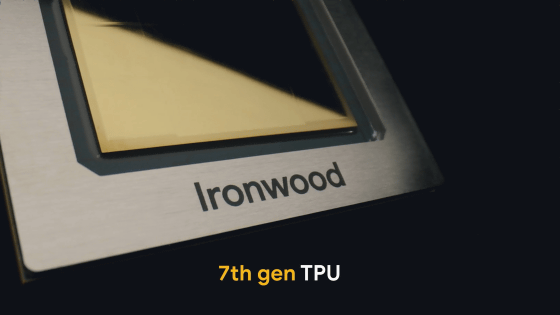
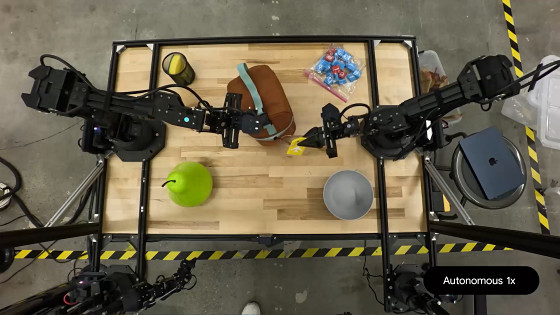
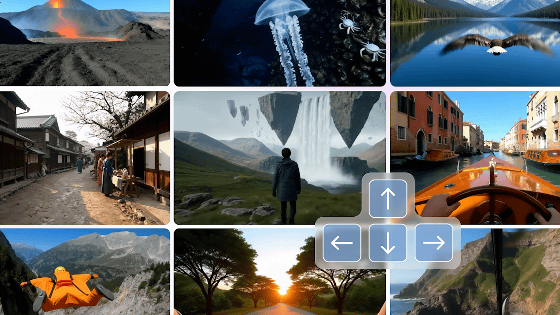
Google's work in robotics and visual understanding includes the AI model Gemini Robotics and the world model Genie 3.
Google releases Gemini Robotics, an AI model for robotics that lets robots perform tasks simply by giving verbal instructions - GIGAZINE
Addressing global challenges and opportunities
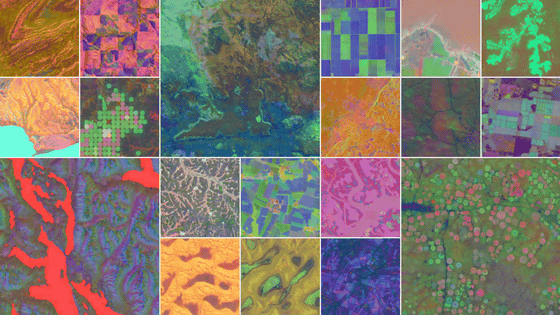
Our 2025 work demonstrates how AI-powered scientific advances are being directly applied to solving some of the world's most serious and far-reaching challenges. By leveraging cutting-edge foundational models and agent-based reasoning, we are dramatically increasing our understanding of the Earth and its systems, while delivering impactful solutions in areas critical to human thriving, including climate resilience, public health, and education.
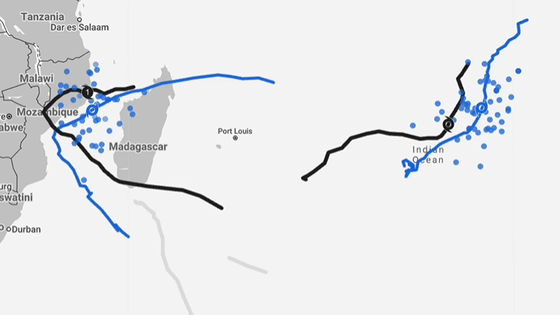
Google's work on weather, mapping, and wildfires includes:
Google launches 'Weather Lab' that uses AI to predict and warn of typhoons, hurricanes, and cyclones - GIGAZINE

In the medical field, we have announced 'Cell2Sentence-Scale 27B,' a cell analysis AI that is useful in cancer treatment.
Google develops cell analysis AI 'C2S-Scale 27B' useful for cancer treatment etc. - GIGAZINE
Looking ahead to 2026, Google said, 'We look forward to continuing to develop cutting-edge technology safely and responsibly for the benefit of humanity.'
Related Posts: