Research results show that about 40% of the signal increase used in fMRI does not correspond to actual brain activity
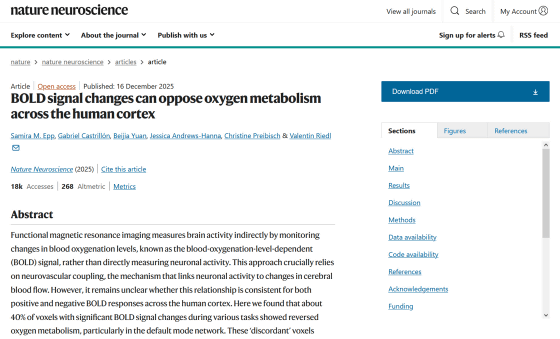
BOLD signal changes can oppose oxygen metabolism across the human cortex | Nature Neuroscience
https://www.nature.com/articles/s41593-025-02132-9
40 percent of MRI signals misinterpreted - TUM
https://www.tum.de/en/news-and-events/all-news/press-releases/details/40-percent-of-mri-signals-do-not-correspond-to-actual-brain-activity
fMRI, which measures neural activity based on the BOLD signal, is based on the assumption that increased neuronal activity increases oxygen demand and stimulates localized blood flow to accommodate this demand. However, it is unclear whether this assumption is consistent across the entire human cerebral cortex.
A research team from the Technical University of Munich (TUM) and Friedrich-Alexander University Erlangen-Nuremberg (FAU) in Germany conducted an experiment on more than 40 healthy subjects.
Using a novel quantitative fMRI technique, the researchers measured the actual oxygen consumption of the participants' brains while they performed tasks known to induce predictable BOLD signal changes in various brain regions, such as mental arithmetic and autobiographical memory recall.
'The results varied depending on the task and brain region. For example, increases in oxygen consumption in brain regions involved in calculations did not coincide with the expected increases in blood flow. Overall, in about 40% of cases, increases in BOLD signal were associated with decreases in brain activity, and similarly, decreases in BOLD signal were observed in areas of increased brain activity,' the researchers said.
In areas where there was a discrepancy between the BOLD signal and brain activity, the blood supply remained unchanged, but the additional energy demands were met by extracting more oxygen from the blood.
'This contradicts the long-held assumption that increased brain activity is always accompanied by increased blood flow to accommodate increased oxygen demand,' said lead author Dr. Samira Epp of FAU. 'Tens of thousands of fMRI studies worldwide are based on this assumption, so our results could lead to the opposite interpretation in many studies.'
'Many fMRI studies of psychiatric and neurological disorders, from depression to Alzheimer's disease, interpret changes in blood flow as a reliable indicator of neuronal under- or over-activation. Given the limited validity of these measures, these studies need to be reevaluated. Especially in patient groups with vascular changes due to ageing or vascular disease, the measurements may reflect differences in the vasculature rather than neuronal dysfunction,' said Professor Valentin Riedl of FAU and co-author of the paper.
This research has also been a hot topic on the social news site Hacker News , where a user who previously worked on brain-machine interfaces (BMIs) pointed out that the signal-to-noise ratio (SNR) in the field of neural signal measurement is so poor that many of the results in previous papers have been impossible to reproduce.
My previous job was at a startup doing BMI, for research. For the first time I h... | Hacker News
https://news.ycombinator.com/item?id=46289089
Related Posts:




in Science, Posted by log1h_ik