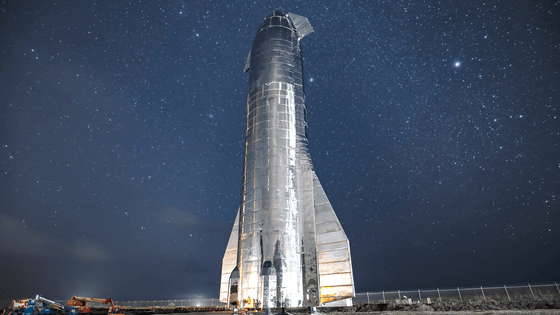
Elon Musk's SpaceX and Jeff Bezos' Blue Origin are competing to develop a 'space-based AI data center.'

As demand for AI grows, data centers are being built in various regions around the world, and plans are underway to launch AI data centers into space. While this may seem like science fiction at first glance, the Wall Street Journal reported that SpaceX, led by Tesla CEO Elon Musk, and Blue Origin, led by Amazon founder Jeff Bezos, are competing to build space AI data centers.
Exclusive | Elon Musk's SpaceX and Jeff Bezos' Blue Origin Race To Bring Data Centers to Space - WSJ
https://www.wsj.com/tech/bezos-and-musk-race-to-bring-data-centers-to-space-faa486ee
SpaceX and Blue Origin have long competed in rocket development and satellite launches, but in recent years they have also been competing to deploy AI data centers in space. According to a person familiar with the matter, Blue Origin has been working with a team for over a year to develop the technology needed for an 'orbital AI data center.' SpaceX also plans to use modified versions of its Starlink satellites to host AI computing payloads, and is reportedly touting this technology as part of a stock sale.
One of the benefits of installing an AI data center in space is that it can generate the enormous amount of power needed to train AI models through solar power.
In November 2025, Musk posted on X, ' Starship will be able to put into orbit approximately 300GW, perhaps 500GW per year of solar-powered AI satellites. The 'yearly' part is what makes this so groundbreaking. The average electricity consumption in the US is about 500GW, so deploying 300GW per year of AI in space would equal more intelligent processing power than the entire US economy in just two years.'
Starship should be able to deliver around 300 GW per year of solar-powered AI satellites to orbit, maybe 500 GW. The “per year” part is what makes this such a big deal.
— Elon Musk (@elonmusk) November 19, 2025
Average US electricity consumption is around 500 GW, so at 300 GW/year, AI in space would exceed the entire US…
At an event in Italy in October, Bezos said that it makes sense to move data centers into Earth's orbit, given the solar power generation capacity available in space. While it will take time for data centers in orbit to become cheaper than building AI infrastructure on Earth, Bezos predicted it could happen in 20 years or less.
Proponents of deploying AI data centers in space envision a large number of satellites in orbit carrying the computing chips that power AI applications. These satellites would fly through space at high speeds, using massive amounts of solar energy to perform the calculations and transmit the data back to Earth.
The idea of setting up an AI data center in space has attracted leaders in AI and space technology, with Google proposing 'Project Suncatcher' in November to build a constellation of satellites equipped with Google's proprietary AI accelerator chip, TPU.
Google proposes 'Project Suncatcher' to equip satellites with AI chips and launch them into space - GIGAZINE
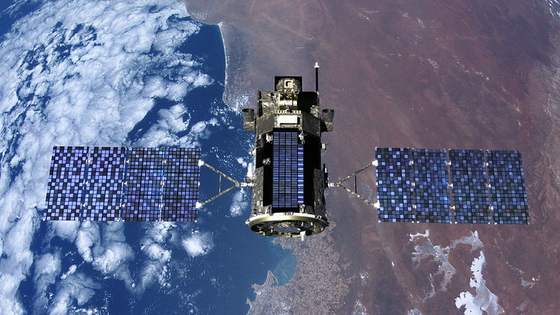
by NASA Goddard Space Flight Center
As a next step, Google plans to launch two prototype satellites by early 2027. This mission is intended to demonstrate the key elements of operating satellites as AI computing clusters.
However, deploying AI data centers in space faces a number of technical hurdles, including how to temperature-control AI chips deployed in orbit, protect them from space radiation, and transmit large amounts of data to Earth without long delays.
The cost of deploying a large number of AI devices in orbit is also an issue. For example, assuming that one satellite is 100kW-class, deploying a GW-class data center in space would require launching 10,000 satellites. Therefore, especially if power constraints on Earth are relaxed, it may become less cost-effective to deploy a data center in space.
Still, many technology leaders are attracted to the idea of deploying AI data centers in space. The Wall Street Journal reported that OpenAI CEO Sam Altman is considering acquiring a rocket company to deploy AI computing in space. Former Google CEO Eric Schmidt, who acquired rocket developer Relativity Space, has also spoken about orbital data centers.
IBM subsidiary Red Hat and space development company Axiom Space announced plans to launch orbital data centers in August, while space solar power technology developer Aetherflux also revealed plans to launch its first data center satellite in early 2027.
The scramble to launch data centers into space is heating up | The Verge
https://www.theverge.com/news/841887/data-center-space-solar-power-aetherflux-lunch
Related Posts: