A new hypothesis for the mystery of 'Why is ice slippery?'

The reason we can glide gracefully across an ice rink is because the surface of the ice is covered with a thin film of water. Scientists believe that this lubricating liquid layer makes the ice slippery, but there is disagreement as to why this layer forms. Quanta Magazine, a science media outlet, explains the hypotheses that have been proposed so far and a new hypothesis proposed in August 2025.
Why Is Ice Slippery? A New Hypothesis Slides Into the Chat. | Quanta Magazine
Cold Self-Lubrication of Sliding Ice | Phys. Rev. Lett.
https://journals.aps.org/prl/abstract/10.1103/1plj-7p4z
Three main theories have been debated over the past two centuries as to why ice is slippery.
The first hypothesis is the pressure hypothesis. In the mid-1800s, British engineer James Thomson proposed that when a person steps on ice, the pressure they apply melts the surface, making it slippery. Ice normally melts at 0 degrees Celsius, but pressure lowers the melting point, so a layer of water can form on the surface even at lower temperatures.
However, in the 1930s, Frank P. Bowden and T. P. Hughes of the Cambridge University Laboratory of Physical Chemistry questioned the pressure melting explanation, deriving from their calculations that the pressure exerted by an average skier was far too small to significantly alter the melting point of ice, and that to do so would require the skier to weigh several thousand kilograms.
The second hypothesis is the friction theory. Bowden and Hughes, mentioned above, proposed that instead of pressure, ice melts due to heat generated by friction with other objects. They conducted experiments and concluded that when a material that easily absorbs heat rubs against ice, the heat required to melt the ice decreases, making it less slippery. This provided the basis for their theory that melting due to friction is the cause of ice's slipperiness.
However, many scientists disagree with the two scientists' hypothesis because ice begins to slip before frictional heat is generated, i.e., even when the ice is standing upright on the surface. Daniel Bonn's research group at the University of Amsterdam conducted an experiment in which they rotated metal pieces at different speeds and hit them against a skating rink, and found that slipperiness does not depend on speed. Since frictional heat should increase with speed, this result suggests that frictional heat is not the factor that makes ice slippery.
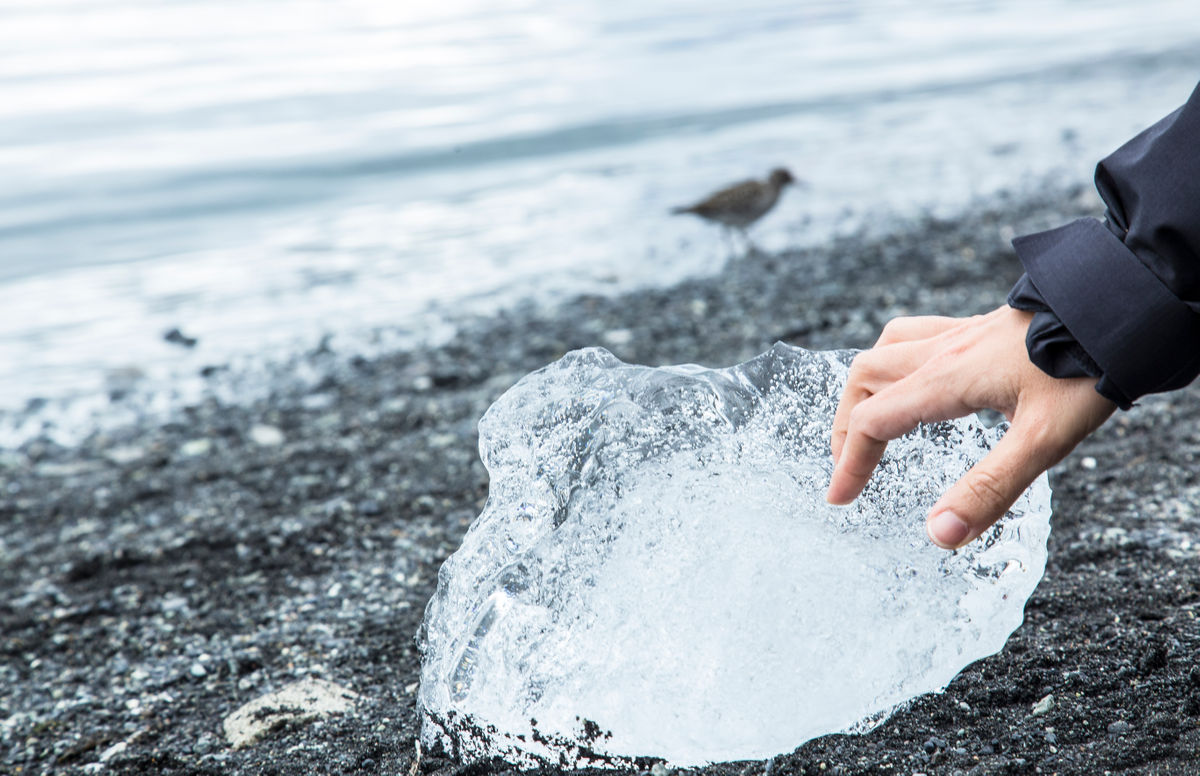
The third is the pre-melting explanation, which states that the surface of ice is already wet before contact. In 1842, British scientist Michael Faraday observed that two ice cubes would freeze together on contact, causing even a warm hand to stick to the ice. Faraday explained this phenomenon as the refreezing of a thin pre-melted layer on the exposed surface of the ice, but he was unable to explain the reason for this phenomenon, and it took about a century for other scientists, such as Charles Gurney and Voldemar Weil, to propose a mechanism for its occurrence.
This theory explains that molecules near the surface of ice behave differently than molecules deeper in the ice. Ice is crystalline, and each water molecule is locked into a periodic lattice structure. However, at the surface, water molecules have fewer neighbors to bond with, giving them more freedom of movement than in solid ice, meaning they can be easily pushed around by skates, skis, or shoes.
Luis McDowell, a physicist at Complutense University of Madrid, and his colleagues conducted simulations to determine which of three hypotheses explains ice's slipperiness is most plausible. Their simulations confirmed that a liquid layer of a few molecules does indeed form on the ice surface, as predicted by the pre-melting theory. Simulations of a heavy object sliding on ice also showed a thicker layer, consistent with the pressure theory. Finally, they examined frictional heat and found that near the ice's melting point, the melted layer was already thick, so the effect of frictional heat was not significant. However, at lower temperatures, the object generated heat, melting the ice and thickening the layer. Based on these findings, McDowell and his colleagues concluded that 'all three hypotheses are simultaneously operating, albeit to varying degrees.'
In 2025, Achraf Attila and his colleagues at Saarland University in Germany presented a counterargument to all three mainstream theories: first, that the contact area between the object and the ice would have to be unrealistically small for the pressure to be high enough to melt the ice surface; second, that the amount of heat generated by friction when skiing at realistic speeds is insufficient to cause melting; and third, that at extremely low temperatures, ice remains slippery despite the absence of a pre-melted layer.
Previous research has shown that when two diamonds slide against each other, the atomic bonds on their surfaces are broken, moved, and new bonds are formed, forming an 'amorphous' layer on the surface that, in contrast to the crystalline nature of diamond, is disordered and behaves more like a liquid than a solid.
Attila and his colleagues argue that a similar mechanism operates in ice. Their simulations of ice surfaces sliding against each other show that friction mechanically disrupts the ice's ordered crystalline lattice, forming an amorphous layer that thickens as the sliding progresses. The team argues that this phenomenon, rather than melting, explains ice's slipperiness, especially at low temperatures.
Both Bonn and McDowell agree with this theory, but there are differences between them: Attila believes that slipperiness is caused by the mechanical displacement of water molecules, while Bonn focuses on the mobility of surface molecules, and McDowell believes that amorphization only occurs at high speeds.
Related Posts:







in Science, Posted by log1p_kr