What is the future of 'AI and humans' predicted from the example of 'engines and horses'?

Horses
https://andyljones.com/posts/horses.html
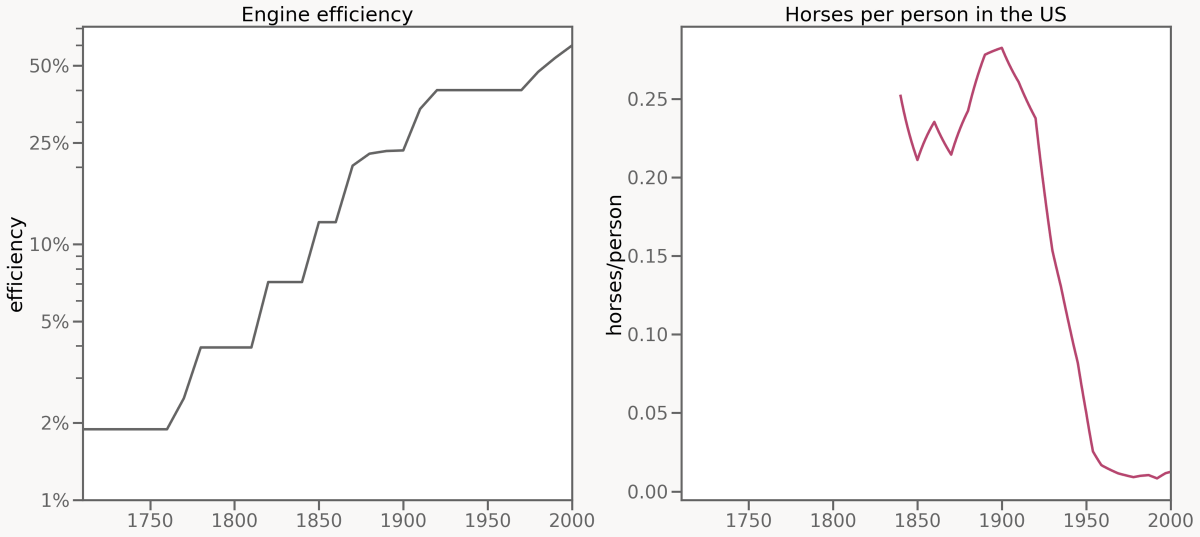
The steam engine, which is the precursor to modern engines, was invented by the British inventor Thomas Newcomen around 1710 as a system to pump water out of mines. The steam engine invented by Newcomen used the difference between vacuum and atmospheric pressure, but it continued to be steadily improved and eventually developed into the engines used in automobiles.
The graph below shows the growth of engine efficiency on the left, with the vertical axis representing engine efficiency and the horizontal axis representing decade. The graph on the right shows the number of horses in the United States, with the vertical axis representing horses per capita and the horizontal axis representing decade. Comparing the graphs, we can see that for the first 120 years or so, as engines steadily improved, the horse population remained stable, but between 1930 and 1950, 90% of horses disappeared. 'The engine's progress was steady,' Jones says. 'Then, all of a sudden, it became comparable to the horse.'
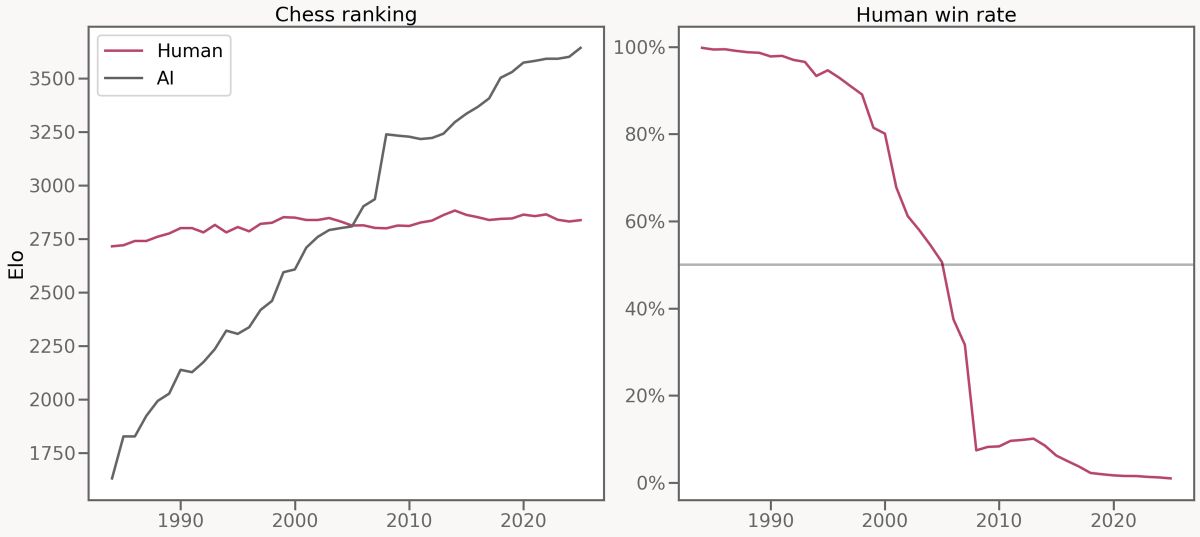
Jones then gave the example of 'AI vs. humans' in chess matches. People began tracking the Elo ratings of computer-based (AI) chess software in 1985. Initially, AI Elo ratings were below 1700, the intermediate level, but they improved by 50 points each year, and by the mid-2000s, they had surpassed top human players.
The graph below compares the Elo ratings of chess AIs with those of elite human chess players, with the vertical axis representing Elo ratings and the horizontal axis representing the decade. The graph on the right shows the percentage results of matches between human chess
Jones then presented the following graph. This graph shows global capital investment in AI as a percentage of US
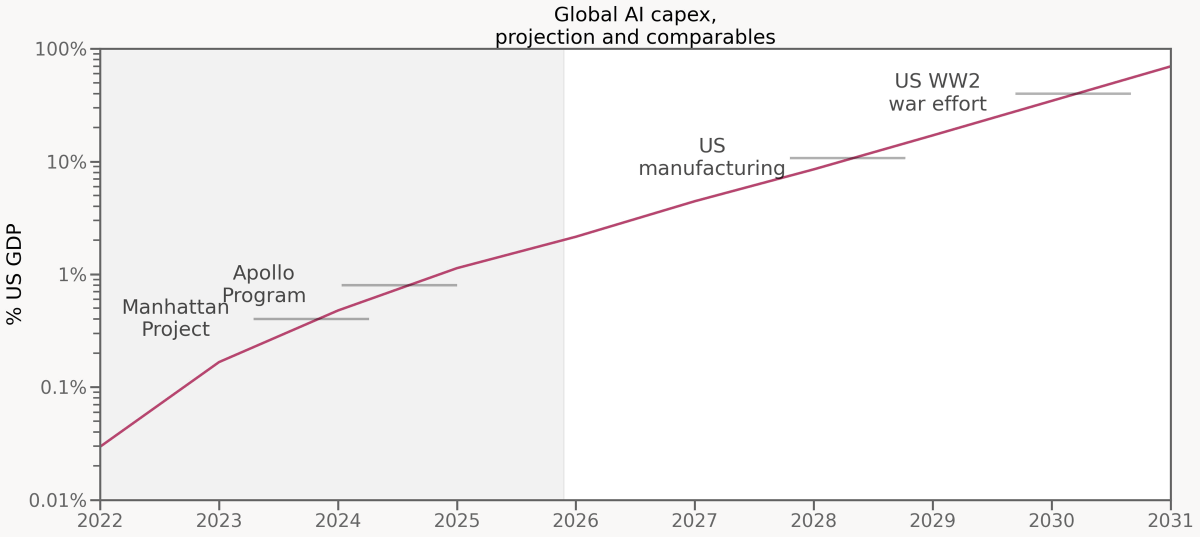
As Anthropic's investment in AI continued to double, changes also came around Jones, an engineer and researcher at the company. As one of the first researchers hired by Anthropic, Jones's job included answering questions for new employees. By mid-2024, Jones was answering about 4,000 questions per month.
However, around October 2024, Anthropic's chat AI, Claude, began answering internal questions. By December of the same year, Claude was able to answer Jones's questions as well, and in 2025, the number of answers to questions exploded. By June of the same year, 80% of Jones's questions had disappeared.
In the graph below, the red line shows the number of questions answered by Jones, and the black line shows the number of questions answered by Claude. The vertical axis shows the number of answers per month, and the horizontal axis shows the year and month. As you can see, the number of answers by Claude has exploded, causing the number of answers by Jones to decrease.
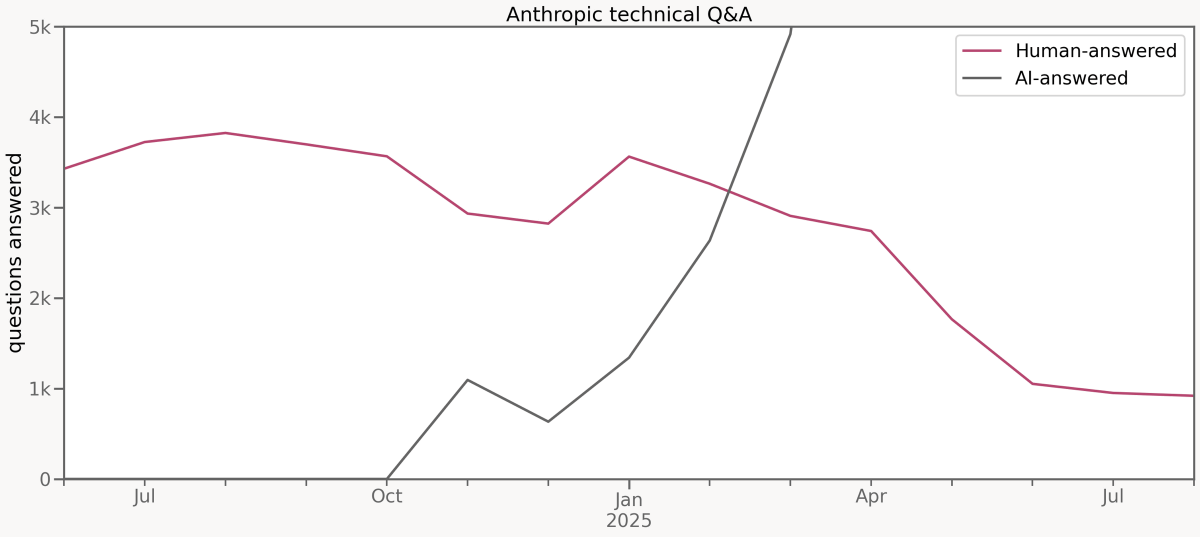
Jones said, 'While it took decades for an engine to beat a horse and years for a chess master to surpass me, it only took six months for me to be surpassed.'
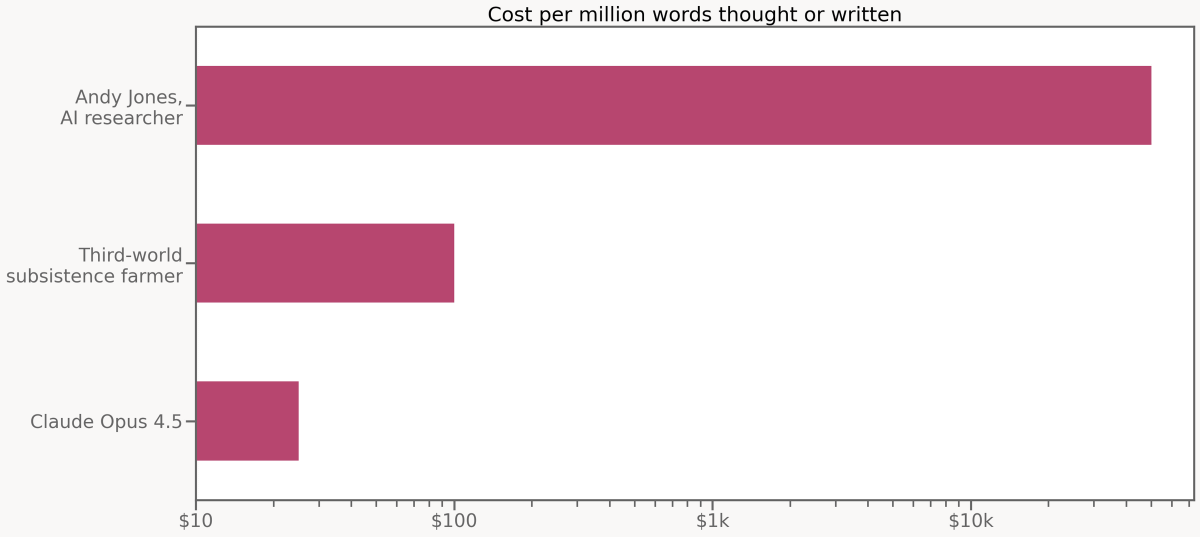
The graph below compares the cost of writing 1 million words for Jones, a large-scale farmer in a developing country, and Claurde Opus 4.5 . Jones commented, 'I've been overtaken by a system that's 1,000 times cheaper than my costs. It's a system that costs less per thought and written word than hiring the cheapest human labor on the planet.'
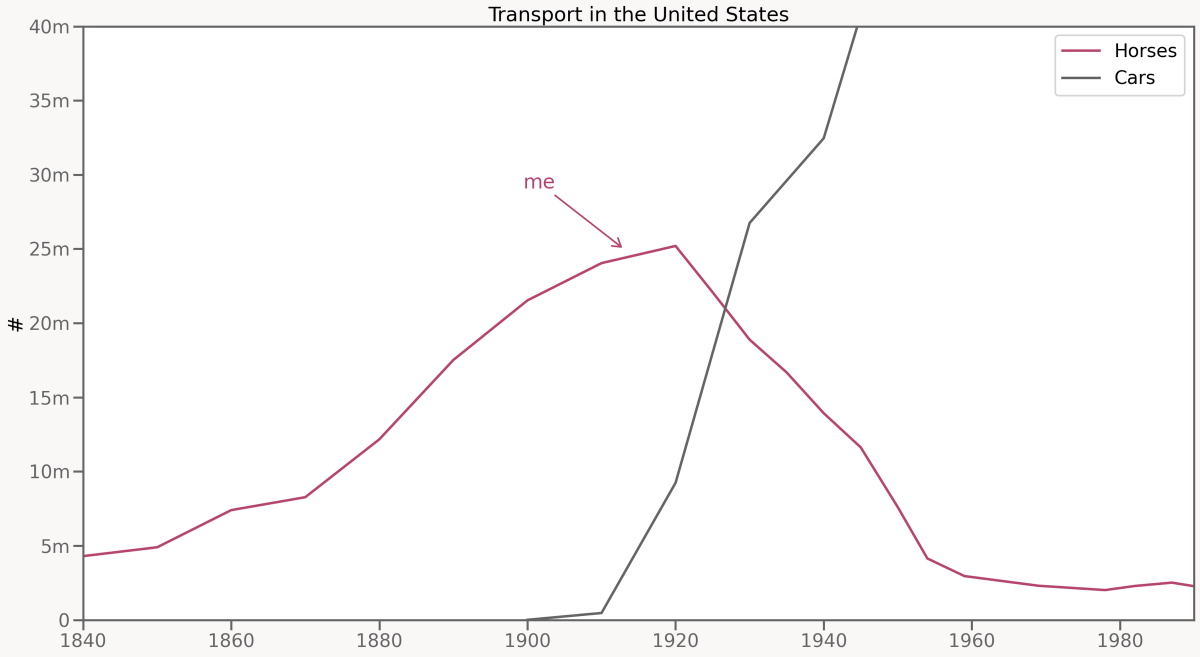
The graph below shows the number of horses in the United States (red line) and the number of cars (black line). The vertical axis represents the number of horses (cars) and the horizontal axis represents the year. In 1920, there were approximately 25 million horses in the United States, but within just a few decades, 93% of them had disappeared.
These examples suggest that the speed at which people's jobs will be eliminated as AI advances may be faster than we imagine. Jones said, 'When I look at how quickly Claude is automating my work, it seems like our burden is being significantly lightened.'
Related Posts:






in AI, Posted by log1h_ik