The next-generation standard for AV1 codec, 'AV2,' is scheduled to be released in 2025. What will it be like?
AOMedia Announces Year-End Launch of Next Generation Video Codec AV2 on 10th Anniversary | Alliance for Open Media
https://aomedia.org/press%20releases/AOMedia-Announces-Year-End-Launch-of-Next-Generation-Video-Codec-AV2-on-10th-Anniversary/
The following movie explains AV2 from about 12 minutes and 30 seconds.
The Future of Innovation is Open Webinar 2025 - YouTube
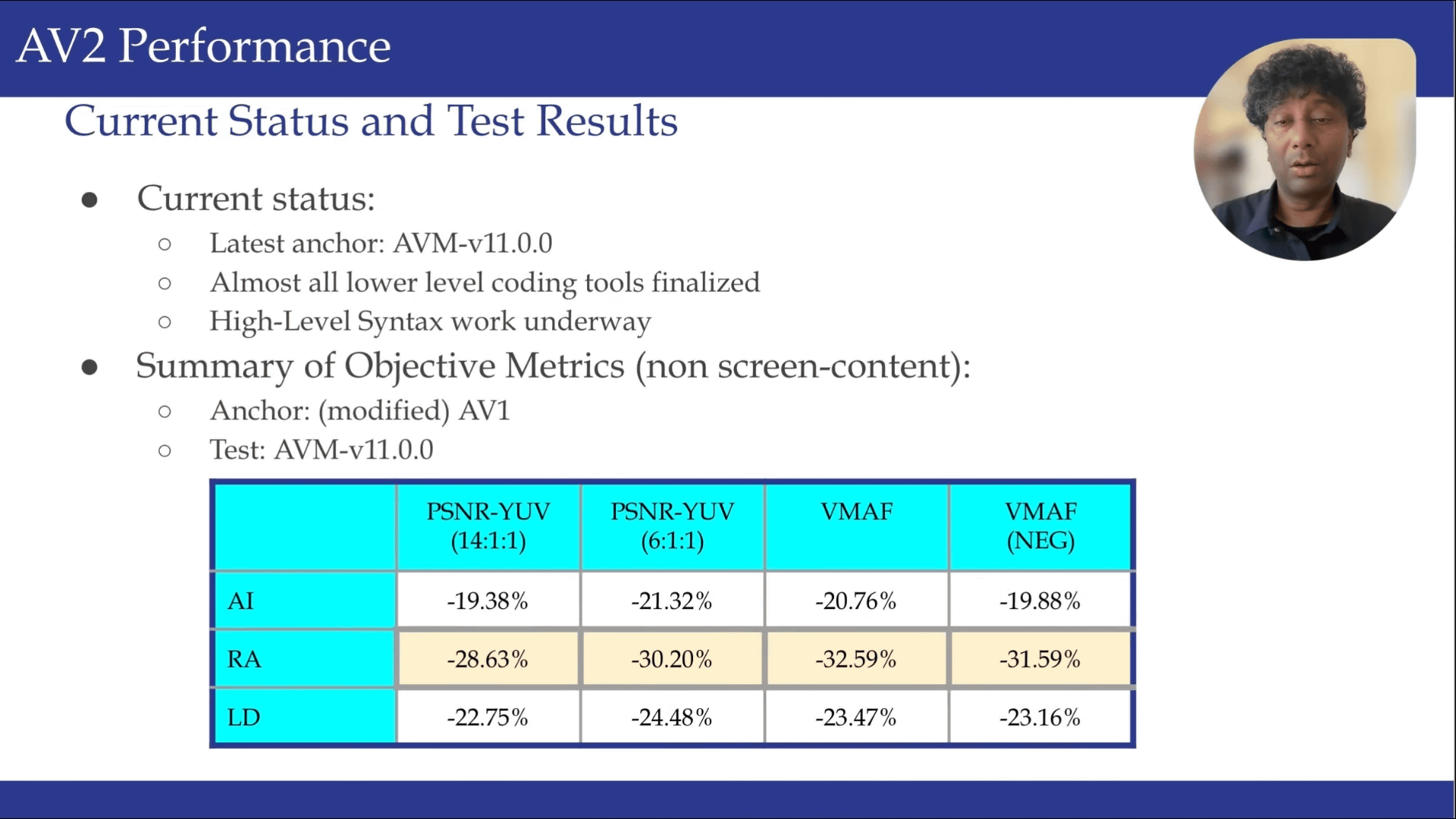
Google's Debargha Mukherjee reported that the AOMedia Video Model (AVM), the experimental software used to develop and verify the next-generation AV2 standard, is updated every four months. He pointed to version 11, the latest version at the time of writing, and argued that the goal of 'reducing bandwidth by 40% while maintaining the same perceived quality as the previous generation, AV1,' is becoming a reality.
At the time of writing, AV2 achieved a 28% to 30% reduction in PSNR, a mathematical image quality evaluation metric, and a 32.6% reduction in VMAF, a metric closer to human perception, according to Mukerjee. These objective figures demonstrate that AV2 has achieved significant performance improvements over AV1, as originally planned.
According to Mukerjee, the technical foundation of AV2 is not a fully AI codec, but rather a 'hybrid codec' approach that incorporates AI (data-driven) tools into conventional technology. This is to keep the load during playback within a realistic range, and the decoder has been strictly designed to have a complexity and chip area that does not exceed twice that of AV1. Mukerjee said that within these constraints, ingenuity has been put into maximizing processing power while minimizing computational load and memory bandwidth.
In terms of specific video processing technologies, image division and conversion techniques have become more flexible, and advanced modes that utilize
In particular, the in-loop filters that perform the final image quality adjustments have been completely revamped. AV2 employs new technologies, such as a combination of pre-trained models and conventional filters, as well as a completely data-driven 'Guided Detail Filter,' to improve the expressiveness of details. These technological innovations are expected to achieve compression efficiency that exceeds that of live-action video for screen content such as PC screens and game footage.
It also offers enhanced flexibility as a video format. From the initial release, in addition to the common 4:2:0 format, it is planned to support extended chroma formats such as 4:2:2 and 4:4:4, which are required for professional and high-quality applications.
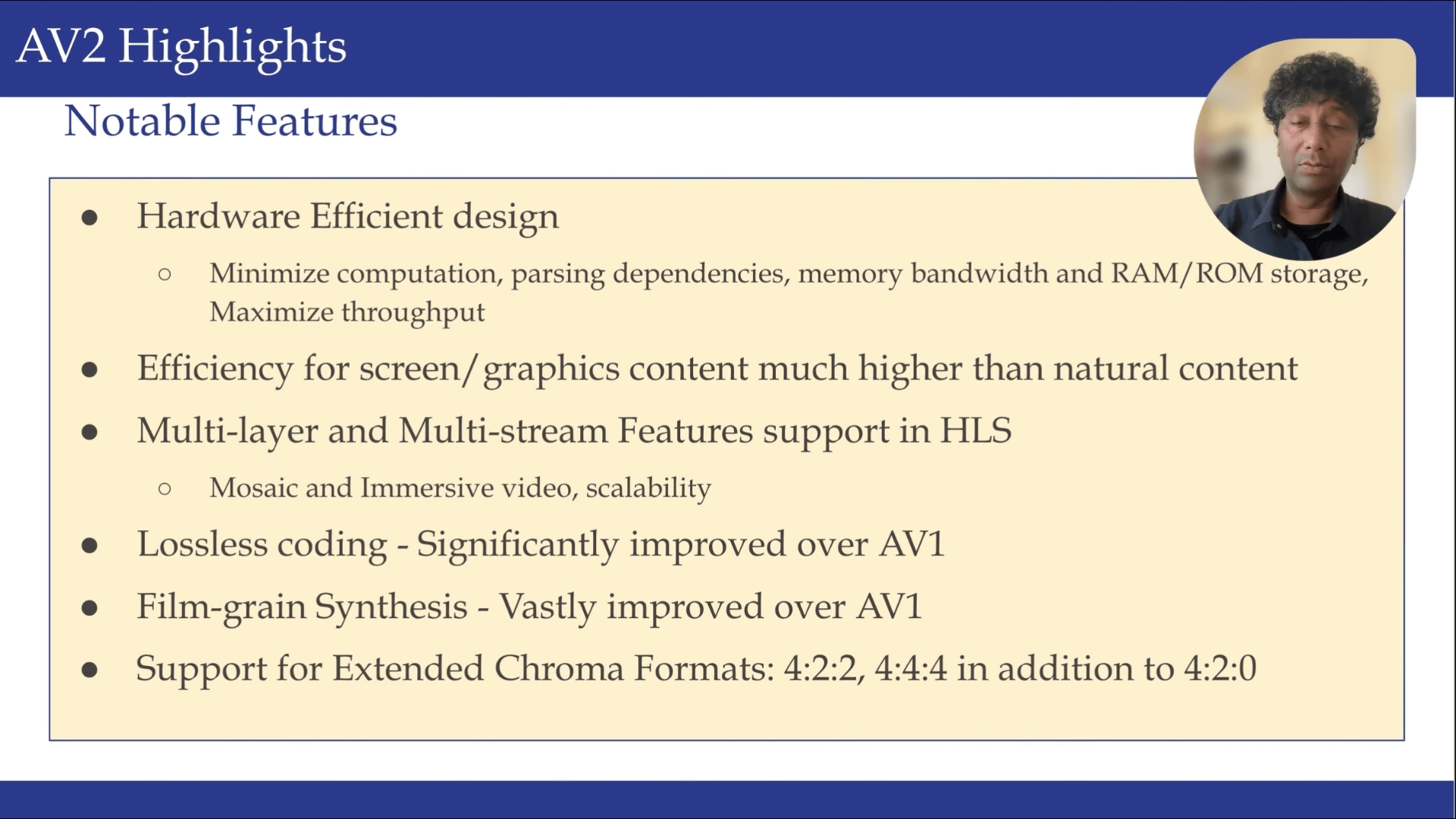
Mukerjee also reported that the technology includes a multi-stream function that handles multiple videos as a single stream, and syntax that anticipates support for immersive video. This means that it is evolving beyond simply improving compression rates to become a fundamental technology that will support a variety of future use cases.
Related Posts: