Research results show that signs of cognitive decline can be detected from 'elderly driving patterns'

While many people drive cars every day without even thinking about it, driving actually requires advanced cognitive functions. A research team at the University of Washington in the United States has recently announced the results of a study that shows that 'signs of cognitive decline can be read from driving data.'
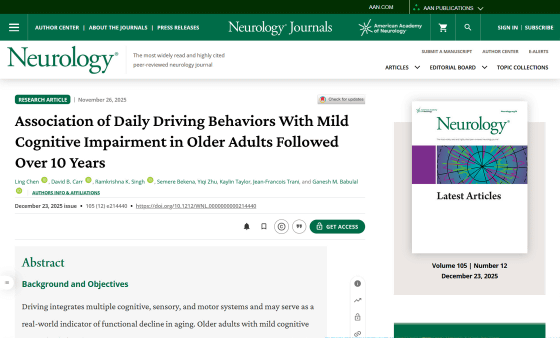
Association of Daily Driving Behaviors With Mild Cognitive Impairment in Older Adults Followed Over 10 Years | Neurology
Can your driving patterns predict cognitive decline? | AAN
https://www.aan.com/PressRoom/Home/PressRelease/5298
Your Driving Choices Could Be Hiding Signs of Future Cognitive Decline : ScienceAlert
https://www.sciencealert.com/your-driving-choices-could-be-hiding-signs-of-future-cognitive-decline
Driving a car requires the integration of multiple cognitive, sensory, and motor functions, putting drivers at a higher risk of accidents. In fact, older adults with mild cognitive impairment (MCI), a precursor to dementia, may experience subtle changes in their driving patterns before receiving a formal dementia diagnosis.
However, there is limited real-world longitudinal data on changes in driving patterns among older adults as their cognitive function begins to decline. 'Early identification of older drivers at high risk for crashes is a public health priority, but identifying risky drivers is difficult and time-consuming,' said Dr. Ganesh Babulal of the University of Washington School of Medicine.
Therefore, Babulal and his research team conducted an experiment to investigate whether it was possible to distinguish between elderly people with mild cognitive impairment and those with normal cognitive function using everyday driving data.
The study involved 298 elderly drivers with an average age of 75 who lived nearby and participated in the University of Washington's Real-Life Vehicle Driving Assessment System project. Fifty-six of the participants had been diagnosed with mild cognitive impairment, while the remaining 242 had no cognitive problems. The drivers reported driving at least once a week at the start of the study.
The researchers administered cognitive tests to participants, including tasks related to memory, attention, and executive function, and collected driving data over a period of up to 40 months using data trackers installed in their vehicles.

At the beginning of the study, both groups had similar driving patterns, but over time, older adults with mild cognitive impairment showed significant changes in their driving routines, including the number of times they drove each month, how often they drove at night, and the routes they drove.
Analysis of the data showed that older people with mild cognitive impairment tended to drive less over time, avoid driving at night, go to fewer places, take simpler routes, and drive slower.
The researchers reported that using only these driving data, they were able to predict the presence or absence of mild cognitive impairment with 82% accuracy, but when they added other factors, such as demographic characteristics like age, cognitive test scores, and the presence or absence of genes associated with Alzheimer's disease, the accuracy rate increased to 87%.
'When we looked at predicting mild cognitive impairment based solely on other factors, excluding driving data, the accuracy rate was only 76%. 'We found that using GPS tracking data can more accurately identify people with cognitive problems than simply looking at factors like age, cognitive test scores, or the presence or absence of genetic risk factors for Alzheimer's disease,' Babulal said.
Although the changes in driving patterns of older adults with mild cognitive impairment may be due not only to cognitive decline but also to the development of self-control abilities associated with aging, these findings suggest that changes in driving patterns may be an early sign of cognitive decline.

'Observing people's everyday driving behaviour is a relatively low-intensity and unobtrusive way to monitor their cognitive abilities and functioning,' said Babulal. 'This could allow for early identification and intervention of high-risk drivers before they cause the accidents and near misses that are becoming so common today.'
The majority of drivers in this study were well-educated and white, so the results may not be generalizable. The research team plans to test their hypotheses in a larger, more diverse group of people, adding data on vehicle type, geographic area, and other health conditions that may be related to the outcomes.
Related Posts:








in Free Member, Science, Vehicle, Posted by log1h_ik