Famous singers have shorter lifespans than less famous singers, and becoming 'famous' may increase the risk of death

With the news often reporting the deaths of singers and artists, some people may feel that 'famous people tend to die early.' A new study comparing 'famous singers' with 'less famous singers' has revealed that famous singers tend to live shorter lives than relatively less famous singers.
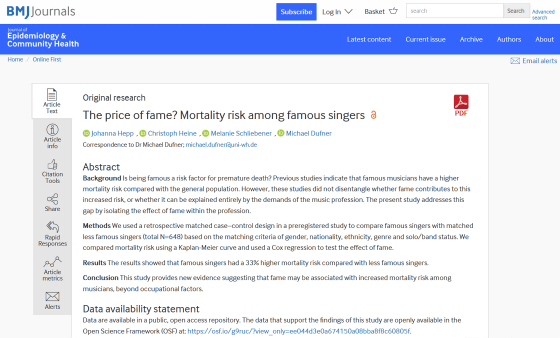
The price of fame? Mortality risk among famous singers | Journal of Epidemiology & Community Health
Fame Can Cut Years From a Singer's Life, Study Reveals : ScienceAlert
https://www.sciencealert.com/fame-can-cut-years-from-a-singers-life-study-reveals
While many people may admire the celebrities they see on TV and social media, it's said that celebrity comes with hardships and risks. In fact, past studies have shown that famous musicians tend to die earlier than the general population. Famous musicians in North America and Europe have a mortality rate two to three times higher than the general population within two to 25 years of achieving fame, and their suicide rate is two to seven times higher than the national average.
However, previous studies have not been clear whether the increased mortality rate is due to fame itself, or to the pressures and demands unique to the music industry, which faces challenges such as irregular schedules, financial instability, and social isolation, and may face many different circumstances than the general population.
So a research team from the University of Witten-Herdecke in Germany decided to fill this gap by studying singers with different levels of fame within the same music industry.

The research team compared 324 famous singers active between 1950 and 1990 with 324 less famous singers who were matched by gender, age, nationality, ethnicity, genre, and band status (solo or band). The famous singers were selected from
The analysis found that the average age at death for famous singers was about 75, while the average age at death for less famous singers was about 80. This suggests that while fame brings great wealth and economic affluence generally leads to better health, fame may not help singers live longer.
'When subjected to rigorous testing, our results reveal that celebrity status is associated with an increased risk of mortality. This highlights the need for targeted health interventions for individuals in the public eye and may stimulate future research exploring the causal mechanisms underlying the observed mortality rates,' the research team wrote in their paper.
The graph below shows famous singers in red and less famous singers in blue, with the vertical axis representing survival rate and the horizontal axis representing age. The difference in mortality rate between famous and less famous singers begins as early as their 20s, and the less famous singers tend to have a higher survival rate almost consistently.

This study only examined the relationship between fame and mortality risk in singers, so it doesn't directly prove that fame leads to early death, and it's unclear whether the results apply to actors, athletes, etc. However, the clear difference in statistics suggests that fame does have some effect on mortality.
When the researchers took into account the date a singer first appeared on the music charts, they found that the increased risk of death appeared after the singer achieved fame, supporting the hypothesis that fame is a factor that modifies mortality risk.
The researchers point out that the link between fame and mortality may be due to 'psychosocial stressors,' such as loss of privacy, public scrutiny, and the pressure to perform at a high level in front of a large audience, which can increase psychological distress and the reliance on harmful coping strategies.
The researchers also found that solo artists, regardless of their fame, had a higher mortality risk than band members, possibly due to the protective effect offered by bandmates and the division of public speaking duties within bands.
'It appears that the harms of fame outweigh the potential benefits associated with high socioeconomic status,' the research team said. 'This finding may be useful in promoting the health and well-being of not only musicians in the public eye, but the broader population, as celebrities often act as role models, shaping public perceptions and influencing health-related behaviors.'
Related Posts:







in Science, Posted by log1h_ik