Conan Doyle explored men's mental health through 'Sherlock Holmes'

Emma Linford, an honorary researcher at the University of Hull in the UK, argues that Arthur Conan Doyle, the creator of the world-famous detective Sherlock Holmes, used Holmes to highlight taboo topics such as male fragility and mental health issues.
Arthur Conan Doyle explored men's mental health through his Sherlock Holmes stories
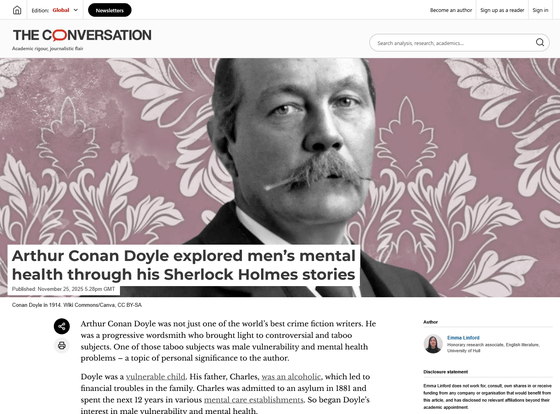
Sherlock Holmes, the quintessential detective, is known for his genius deductive abilities, but he is not a perfect human being, and is also portrayed as someone who struggles with drugs, loneliness, and depression. Linford points out that Doyle did not make Holmes an absolute being, but rather a person who can gain sympathy from others. He also says that he is a character who truly represents 'the 'fragility' of men, which is different from weakness.'
Linford points out that Doyle's own 'fragile' childhood was the reason for his interest in male fragility and mental health. His father, Charles, was an alcoholic, and the family struggled financially. Charles lost his job as an assistant surveyor in 1874, when Doyle was 25, and was committed to a mental hospital seven years later in 1881. Charles, who was also an illustrator, provided illustrations for Doyle's 1887 novel, 'A Study in Scarlet,' in which Sherlock Holmes first appears, before dying in 1893.

Linford pointed out that many of Holmes' stories feature male characters facing emotional ruin, betrayal and moral dilemmas, and that Doyle was exploring the social expectations placed on 'masculinity' in the Victorian era at the end of the 19th century and how men struggled with those pressures.
If I were to name a specific work, it would almost always involve spoilers that would reveal the core of the work, so it's difficult to say specifically 'which character from this work,' but one character who is physically and mentally scarred from the moment he appears is Victor Hatherley, a hydraulic engineer who appears in 'Engineer's Thumb.'
This work has a somewhat unusual plot in which Hatherley, who has lost his thumb, visits the doctor Watson seeking treatment, and from there ends up seeing Holmes.
Victor lost a thumb as a result of an extremely brutal act of violence, and the damage has also affected his mental health. Holmes, therefore, listens to Victor's story with concern for him and asks him about what happened to him. Linford argued that the structure in which Watson treats Victor's physical pain while Holmes comforts him for his mental trauma shows the importance of psychological support for men at the time.
Sherlock Holmes' career spans 40 years, from the publication of A Study in Scarlet in 1887 to Shoscombe House in 1927. Linford says that readers at the time saw Holmes's drug use and the various problems his clients faced as 'a testament to Holmes' genius, not a reflection of the serious issues they themselves faced,' but that for modern readers, they offer a window into the struggles of Victorian men, connecting readers of the past and present.
Incidentally, Doyle reflected in his autobiography that his father, Charles, was the cause of his 'fragile' childhood, writing, 'It was full of the tragedy of insufficient strength and underdeveloped talent. Like us all, my father had his shortcomings, but at the same time he had his outstanding strengths.' Furthermore, in Holmes's final work, 'The Last Farewell,' Doyle uses his father's middle name, Altamont, as Holmes' pseudonym. Furthermore, in 1924, he held an exhibition of his father's work, which was praised by the playwright George Bernard Shaw.

Related Posts:








in Note, Posted by logc_nt