Test to tell if a video is real or AI-generated, and what are experts' advice for identifying AI-generated videos?
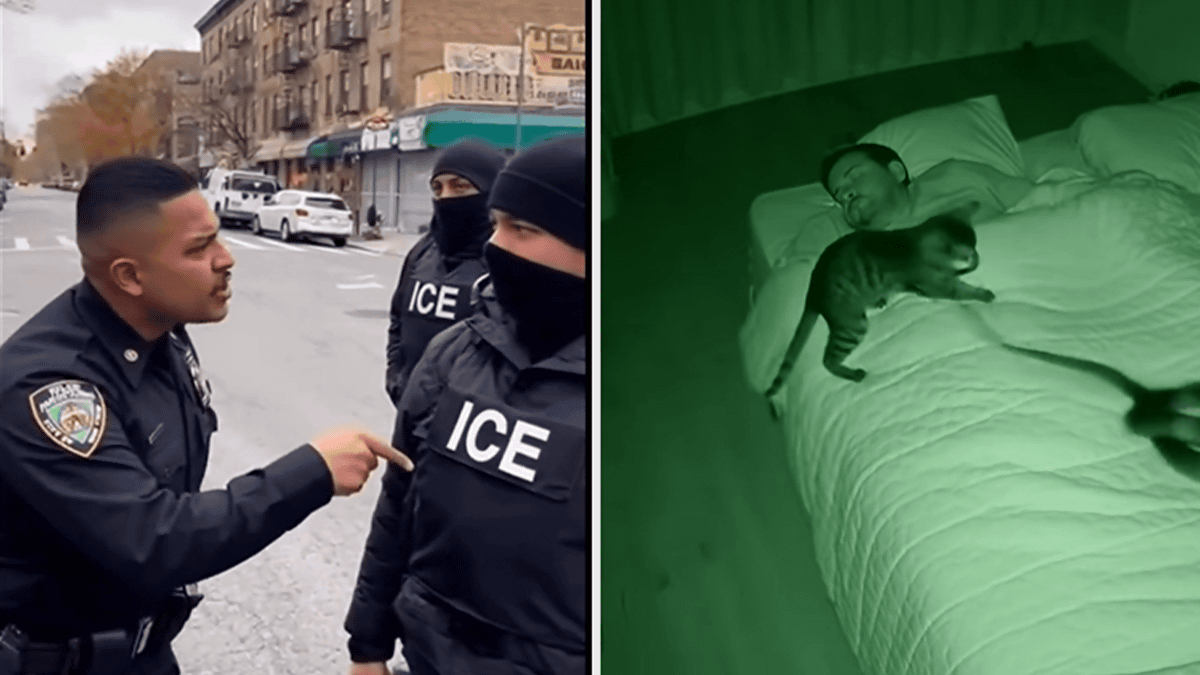
As AI advances, the quality of AI-generated videos has improved dramatically, making it difficult to distinguish them from real footage.
Can you spot AI videos from real ones? Take our quiz : NPR
https://www.npr.org/2025/11/30/nx-s1-5610951/fake-ai-videos-slop-quiz
There are four questions in the quiz. To take the quiz, first go to the NPR website , scroll down, and watch the first video. The first question is a New York police officer yelling at the U.S. Immigration and Customs Enforcement (ICE).
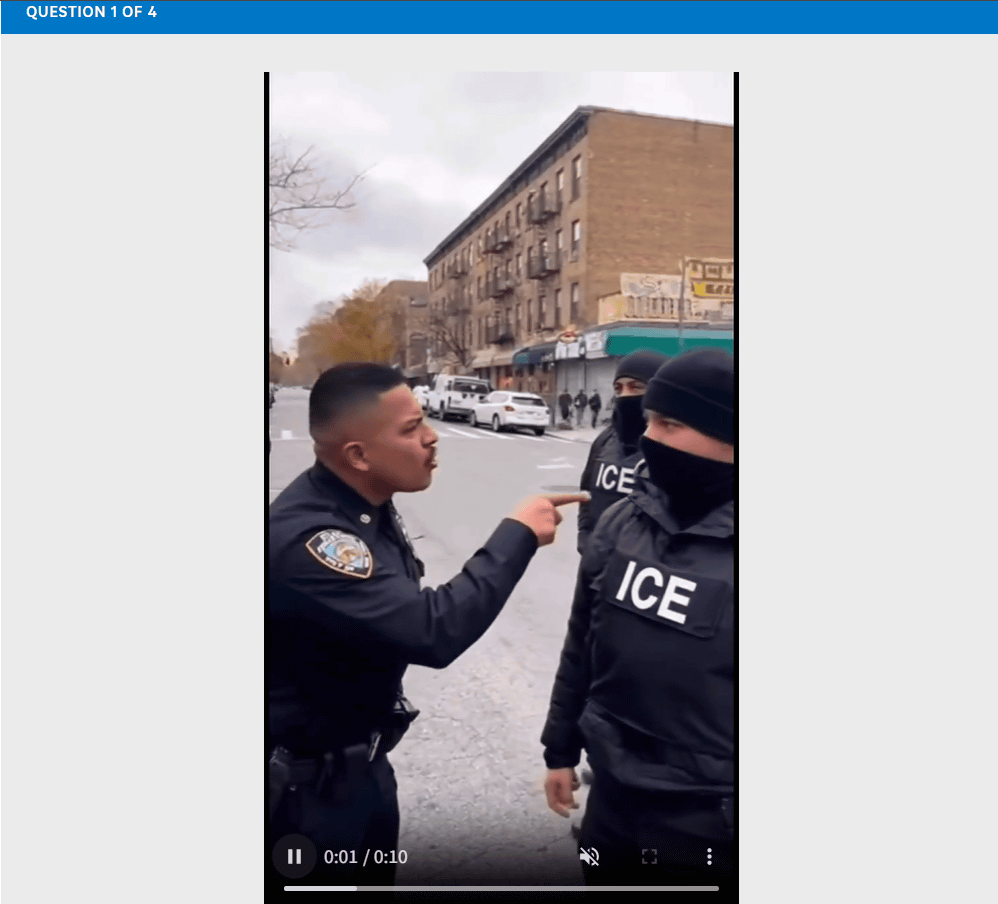
After watching the video, you can scroll further and choose between 'This is AI generated, duh.' and 'This is real.' This time, at first, I thought the realistic human movements were authentic, but then I noticed something strange about one of the ICE officer's eyes flashing, so I chose 'This is AI generated, duh.'
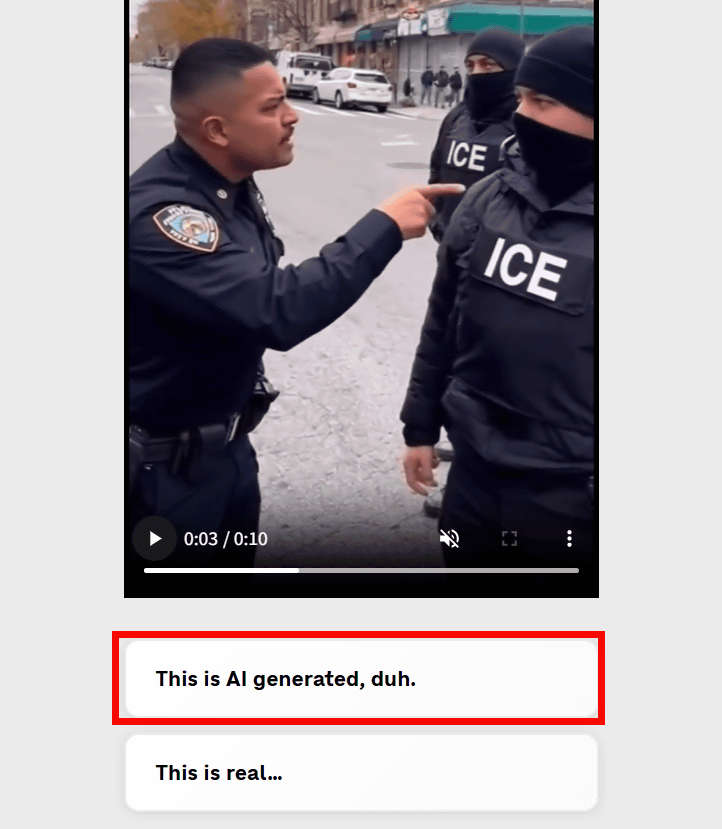
The result was a message saying 'GOLD STAR!' and an explanation. The explanation explained that there was something very strange about the scenario: 'It's strange that a police officer is being filmed right next to a scene where he's yelling at an ICE agent.'

If you choose an incorrect answer, 'NOPE...' will be displayed, along with the same explanation as if you chose the correct answer.

The second question was about a video of a masked person throwing what appears to be a smoke bomb from a car, with the camera zooming in and out.
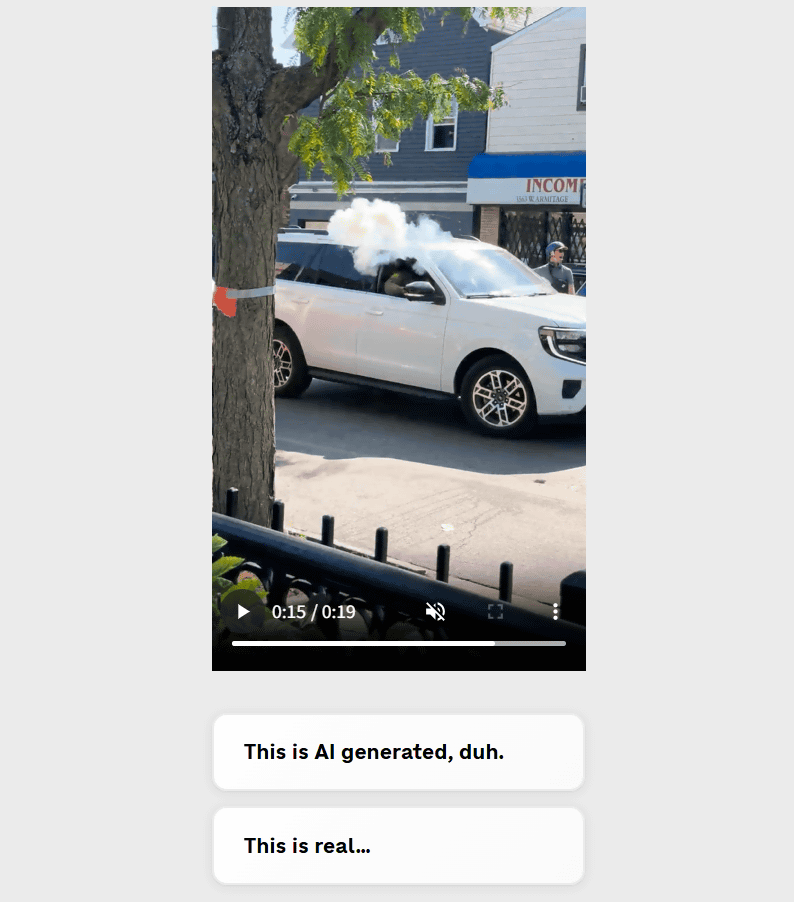
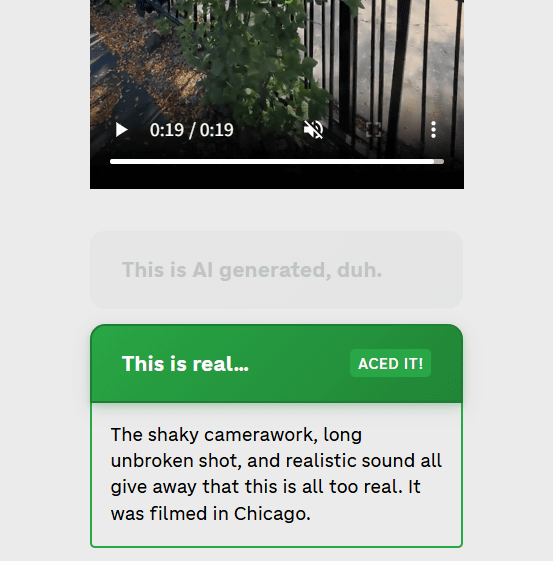
The second video is real. Shaky camerawork and realistic sound are apparently characteristics of real videos that were actually filmed. Also, the first video is 10 seconds long, while the second video is 19 seconds long. AI that generates realistic videos is often only capable of videos of around 10 seconds, so creating a longer video requires combining multiple generated videos. Therefore, a single-shot video of a certain length is more likely to be real.
In the video below, a counter attendant films a large animal entering a store and munching on popcorn. The date and time are displayed in the top right corner, making it appear to be security camera footage.
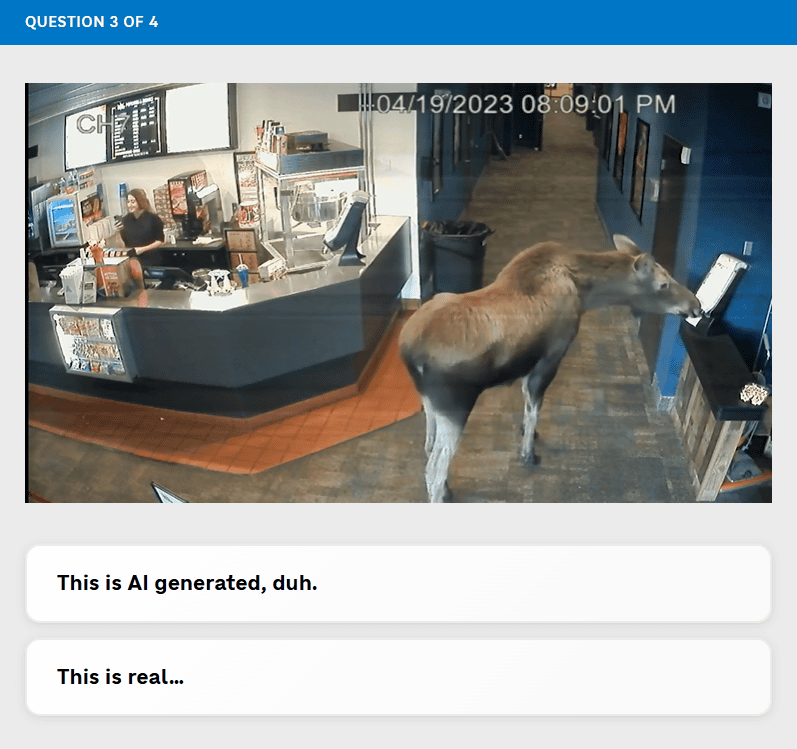
I thought there was something odd about the animal's movements while eating popcorn, so I selected 'This is AI generated, duh.' However, the answer was incorrect and it was actual footage. According to the explanation, AI-generated videos are not good at displaying dates to make them look like they were taken from a security camera.

The fourth question was about a man sleeping soundly when a snake crawled onto his bed and was about to attack him, but a cat jumped in and killed the snake.
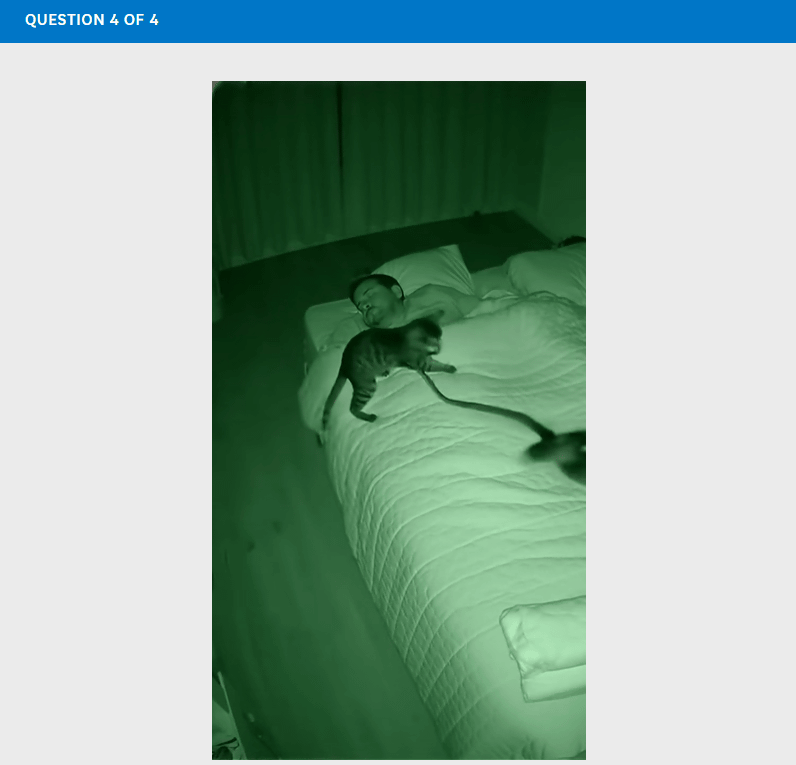
The fourth video is a famous AI-generated video that has been viewed over 5 million times on TikTok. According to the explanation, night vision and jerky security camera footage are often generated by users trying to create fake videos to hide the quality flaws of AI-generated videos. However, unlike the third question, which involved a security camera installed in a store, the fourth question has a strange scenario in which the person is filming their own bed with a ceiling camera.

After answering four questions, the results were displayed. Professor Hany Farid, who studies media manipulation at the University of California, Berkeley, then explained how to distinguish between real and AI-generated videos. According to Professor Farid, it is difficult to distinguish between AI-generated videos, so even experts can be fooled, but there are some relatively easy-to-understand characteristics.
One obvious feature is the length of the video, as mentioned in the quiz explanation. AI-generated videos are often 8 to 10 seconds long, so it's important to be wary of short videos. AI-generated videos also tend to capture the subject perfectly, so videos like the first question, which shows 'close-up footage that couldn't have been shot that close up,' or the fourth question, which shows 'even though the video is short, the action begins and ends beautifully,' raise suspicions of AI.
Mike Caulfield, a research scientist at the University of Washington's Center for Information and Public Affairs and co-author of the book ' Verified: How to Think Straight, Get Duped Less, and Make Better Decisions About What to Believe Online,' said that not only the characteristics of a video but also 'where it's shared' are important. For example, by checking where the second video was first shared, we can see that it was posted by a Reddit community in Chicago's Logan Square district, which allows us to determine the type of person who posted it and whether they are trustworthy. 'It may be easy to fake a video, but it's hard to create a history of 10 years of talking about Chicago hot dogs and convince viewers,' Caulfield said.
Corinna Koltai, a senior researcher at Bellingcat , a Netherlands-based organization specializing in social media information research and video data analysis, warned, 'Feeds on social media and short video apps are flooded with a huge amount of false information. However, assuming that everything you see online is fake for that reason is just as dangerous as believing everything you see is true.' She also pointed out that much of the AI-generated content is intended to gain engagement, and that sharing it with others in a way that makes it difficult to identify who posted it is not considerate, so caution is needed.
Related Posts:





in Free Member, AI, Posted by log1e_dh