Research shows that people who perceive themselves as having a high social status are less able to sense other people's emotions

Humans are highly social animals, and successful interactions with other humans are closely linked to personal success. Understanding how others feel and think is crucial to successful interactions with others. However, new research suggests that people who perceive themselves as having a high social status are less able to sense the emotions of others.
Higher self-assessed subjective social status is associated with worse perception of others' emotions | Scientific Reports
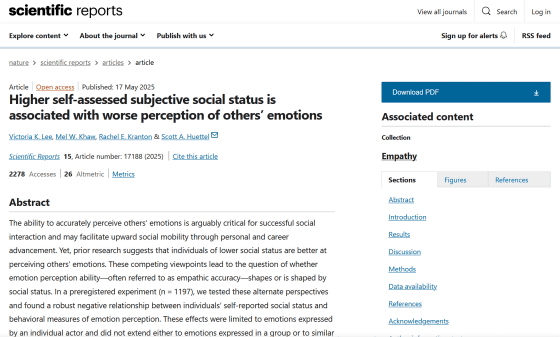
Individuals perceiving their social status as higher tend to be worse at perceiving emotions of others
https://www.psypost.org/individuals-perceiving-their-social-status-as-higher-tend-to-be-worse-at-perceiving-emotions-of-others/
Some research suggests that our ability to correctly identify emotions in others is influenced by social status—our relative standing or rank within a group or society—which shapes how we are treated by others and determines our respect, trust, and influence in social interactions.
During evolution, high social status increased the chances of survival by providing better access to resources, mates, and physical protection. Today, social status influences access to education, health care, and economic opportunities, and is also related to psychological well-being. In contrast, low social status reduces the chances of survival and can lead to increased stress, anxiety, and feelings of exclusion.
Recent research has shown that people with low social status rely heavily on their ability to perceive other people's emotions in their interactions. This finding is not surprising, as these social cognitive abilities are crucial for survival in people with fewer resources. However, some argue that improved social cognitive abilities may facilitate interactions with others, ultimately leading to an improvement in an individual's social status.
To answer this question, Victoria Lee, a lecturer in the Department of Psychology and Neuroscience at Duke University, and her research team conducted an online experiment to answer the question: 'Do people with higher social status have better social cognitive abilities, or is this ability unique to people with lower social status?'

The study involved 1,197 American participants recruited through the online experimentation platform
Participants first completed a test measuring their ability to perceive individual emotions, followed by a test measuring their ability to perceive group emotions and a test measuring their ability to perceive non-social tasks. After completing these tests, participants completed scales measuring their subjective and objective social status.
The results of the experiment showed that participants who self-reported a higher subjective social status tended to have a lower ability to recognize emotions expressed by individuals, but this association was not observed for the ability to perceive emotions in groups or in non-social tasks.

The participants' reported subjective social status was not significantly different from objectively measured social status based on income, education level, etc. This suggests that participants assessed their own social status with a certain degree of accuracy.
However, the research team also looked at subjects who rated their own social status relatively high compared to others with similar objective social status. They found that subjects who rated their subjective social status relatively high had poorer emotional perception abilities than subjects who did not. They also found evidence suggesting that increasing self-rated social status over the lifespan is associated with worse emotional recognition.
The research team stated, 'These patterns support the view that social status shapes emotional perceptual abilities, but importantly, this relationship depends on an individual's subjective sense of status, that is, their assessment of their social status relative to others and changes in their status over their lifetime.'
The emotion perception task used in this experiment was to 'judge the emotions of people in photographs,' not to 'identify the emotions of people you have actually interacted with.' Therefore, the results of this study may not be applicable to real life.
Related Posts:








in Science, Posted by log1h_ik