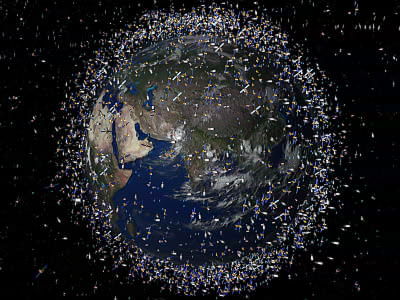
One Japanese object is listed in the latest list of the 50 most worrisome space debris left in low Earth orbit, with most of the rest being Russian-made

When space debris collides with other debris, the debris increases, causing a chain reaction of collisions known as the '
A6.8-E9.1 The Space Triad – Practical Space Operations Framework
https://www.iafastro.org/events/iac/international-astronautical-congress-2025/technical-programme/symposium-keynotes/a68-e91-the-space-triad-practical-space-operations-framework.html
Removing these 50 objects from orbit would cut danger from space junk in half - Ars Technica
https://arstechnica.com/space/2025/10/everyone-but-china-has-pretty-much-stopped-littering-in-low-earth-orbit/
Darren McKnight of LeoLabs , a company that maps low Earth orbit and combats space debris, has compiled a list of space debris in low Earth orbit that could pose a risk if it collide with other debris. Issue 181 of the scientific journal Acta Astronautica, published in April 2021, lists the top 50 dangerous debris as of 2021.
Identifying the 50 most-concerning derelict objects in LEO
(PDF) https://iris.cnr.it/retrieve/3c9394c7-a04f-431a-976d-cdc65afd0b9d/prod_443448-doc_159316.pdf
At the time, the majority of hazardous debris was launched by the Soviet Union and Russia, and four years later, the situation has not changed significantly, with Soviet and Russian launches still accounting for 34 of the top 50. Even just looking at the top 10, the following six are ranked:
1st place: SL-16 rocket (launched in 2004)
5. SL-8 Rocket (launched in 1985)
6. SL-16 Rocket (launched in 1988)
7. Kosmos 2237 satellite (launched in 1993)
8. Kosmos 2334 satellite (launched in 1996)
9. SL-16 Rocket (launched in 1988)
Japan's H-II rocket , launched in 1996, came in third.
According to McKnight, if all of the debris on this top 50 list were collected, the risk of debris in low Earth orbit would be reduced by half. Collecting just the top 10 would reduce the risk by 30 percent.
Meanwhile, 26 rockets have been abandoned in low Earth orbit since early 2024 and are expected to remain there for more than 25 years.
The news site Ars Technica points out that this is because, while the United States and Europe require launch companies not to leave rockets in orbit, China has no such rules. Of the 26 rockets, two are American, one is Russian, one is Indian, and one is Iranian, and the remaining 21 are Chinese.
This trend is expected to continue as China develops its satellite networks, known as the 'State Network' and 'Qianfan.' McKnight said, 'If this continues for several years, we'll have over 100 rockets in orbit. That's not a good trend.'
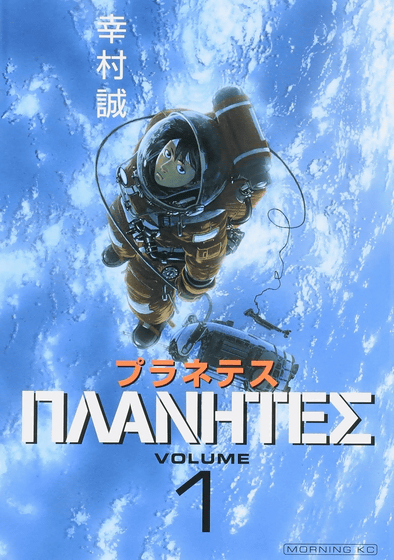
In addition, Makoto Yukimura's manga 'Planetes,' which was also made into an anime in 2006, depicts the protagonist collecting space debris in the 2070s, and touches on the dangers of debris and the Kessler Syndrome in the story.
Amazon.co.jp: Planetes (1) (Morning KC): Makoto Yukimura: Books
Related Posts:


in Science, Posted by logc_nt