In an experiment in which humans were intentionally infected with bacteria, a discovery was made that changes the 'common sense' of drug dosage that had been thought up to now

Penicillin, which is used to prevent infectious diseases, is customarily administered in the 'golden ratio' that was determined in the 1950s for Streptococcus pyogenes. However, a unique experiment in which the bacteria was deliberately used to infect humans revealed that a smaller dosage could be used without any problems.
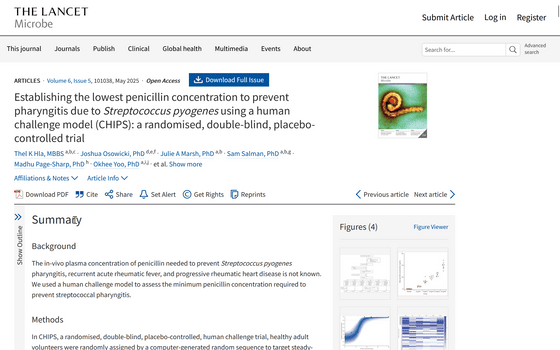
Establishing the lowest penicillin concentration to prevent pharyngitis due to Streptococcus pyogenes using a human challenge model (CHIPS): a randomized, double-blind, placebo-controlled trial - The Lancet Microbe
Deliberately infected lead to penicillin advance
https://medicalxpress.com/news/2025-06-deliberately-infected-penicillin-advance.html
Streptococcus pyogenes (group A beta-hemolytic streptococcus) causes sore throat and acute rheumatic fever, and can lead to life-threatening kidney disease, sepsis, and heart failure. Patients diagnosed with acute rheumatic fever and rheumatic heart disease in particular must receive painful intramuscular injections of benzathine benzylpenicillin once a month for 10 years to prevent reinfection.
The use of benzathine benzylpenicillin has remained largely unchanged since its effectiveness was first demonstrated in the 1950s, with the target blood concentration set at 20 nanograms per milliliter, an amount that has not been verified for a long time. The number '20' is known as the golden standard that should be adhered to, but there is a problem that injecting it into the muscle at this concentration is extremely painful, making it very difficult to adhere to a monthly schedule, and many patients are not receiving all the treatment they need.

So researchers from the University of Western Australia and the Australian Centre for Infectious Disease Research conducted an experiment in which they intentionally administered Streptococcus pyogenes to test how much of the drug was needed to prevent reinfection.
They found that a concentration of penicillin needed to prevent infection was just 8.1 nanograms per milliliter -- less than half the amount that patients have been given for the past 75 years.
'As infectious disease specialists, we don't usually treat patients, but rather intentionally infect them. However, this study was designed to gain groundbreaking knowledge to make fundamental changes to current treatments,' said Lawrence Manning, one of the researchers involved in the study. 'Until now, the exact amount of penicillin that prevents the 'sore throat', the most common symptom of S. pyogenes, was unknown. With a clear goal in mind, we can accelerate the development of a new, long-acting injection that is much less painful and can be administered every three months, ideally into the skin rather than into the muscle.'

Of the 60 participants, 57 completed the maximum 5-day hospitalization and evaluation, and the follow-up visits at 1 week and 1 month. Only 2 participants discontinued the study during their hospitalization. 'This indicates that most participants were able to tolerate participating in the study,' Manning and his colleagues said, noting that the small number of participants in this study was a problem.
Related Posts:




in Science, Posted by log1p_kr