Successfully remove half of mouse head tumor using gene editing technique 'CRISPR-Cas9'

Researchers at Tel Aviv University have announced that they have successfully removed half of a tumor in a mouse's head using
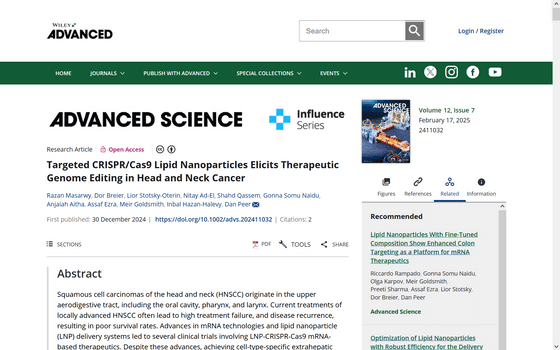
Targeted CRISPR/Cas9 Lipid Nanoparticles Elicits Therapeutic Genome Editing in Head and Neck Cancer - Masarwy - 2025 - Advanced Science - Wiley Online Library
https://advanced.onlinelibrary.wiley.com/doi/10.1002/advs.202411032
CRISPR gene editing breakthrough eliminates 50% of head, neck tumors - The Brighter Side of News
Israeli researchers use gene editing to eliminate 50% of head, neck tumors in mice | The Times of Israel
https://www.timesofisrael.com/israeli-researchers-use-gene-editing-to-eliminate-50-of-head-and-neck-tumors/
The method attempted by Dan Pier and his colleagues at Tel Aviv University was to use CRISPR-Cas9 to remove the protein 'SOX2' that cancer cells need to survive.
According to Pia and his colleagues, SOX2 is active in fetuses, helping young cells develop and grow, but in healthy adults, its activity is suppressed because it is not needed by the body. However, in cancer cells, especially head and neck tumors, SOX2 proliferates again for unknown reasons. This gives the cancer cells stem cell-like powers, allowing them to proliferate rapidly and begin to resist treatment. If SOX2 can be removed, the cancer cells will not be able to survive.
Taking note of this, Pia and his colleagues used the CRISPR-Cas9 technology, which targets SOX2. CRISPR-Cas9 is like a pair of scissors that can cut specific genes in DNA and is known to be able to permanently modify genes with high precision. However, there are concerns that cutting the wrong gene or cutting too many times could cause genetic damage or new cancers.
Peer and his team developed a CRISPR-Cas9 'delivery system' that uses antibodies to target cancer cells. They encapsulated CRISPR in tiny, fat-like bubbles called 'lipid nanoparticles,' and succeeded in delivering CRISPR deep into cancer cells.

Using these techniques, the researchers injected nanoparticles containing CRISPR into tumor-bearing mice three times at weekly intervals, and the researchers found that 50% of the cancer tumors disappeared within 84 days.
This is not the first time that Pia and her team have used CRISPR in cancer research: in 2020, they became the first to use CRISPR to precisely cut genes in mouse cancer cells. But this is the first time they've applied CRISPR to head and neck cancer.

According to Pia and his colleagues, the key point in this study is that they were able to deliver the therapeutic agent without relying on the bloodstream. Relying on the bloodstream would have run the risk of the therapeutic agent reaching healthy organs such as the liver, but this time they injected the agent directly into the tumor, which is easier to control and more precise. It is also important to note that by selecting SOX2 as a target, which is essential for the survival of cancer cells but not essential in most adult cells, the risk of unwanted side effects was significantly reduced.
Pia and his colleagues are already working on using the same technique to treat other aggressive cancers, including myeloma, lymphoma, and liver cancer. The next step will be to test the treatment on other types of tumors before moving to human clinical trials.
Related Posts:






in Science, Posted by log1p_kr