5 habits you should adopt to improve your study efficiency

When you have to memorize a lot of information for school or work exams, everyone wants to improve their learning efficiency. While simply cramming knowledge into your head is one way to do it, The Conversation, a non-profit media outlet providing academic topics, has compiled five ways to improve efficiency based on the characteristics of the human brain.
Study habits for success: tips for students
◆1: Avoid multitasking

By
The human brain is not good at processing multiple things at once. Therefore, when cramming knowledge into your brain, you should create an environment where you can concentrate on that. This is not only because of the obvious distraction of studying while chatting on LINE, but also because playing music in the background has been shown to hinder learning .
In this way, the human brain is distracted by even the smallest external factors, and it takes several minutes to regain focus. Therefore, it is important to avoid creating a multitasking situation.
◆2: Sleep well

By
Sleep is not only necessary for living things to survive, but it is also extremely important for organizing and consolidating memories. It is said that we dream while sleeping because the brain organizes memories, and research has shown that when brain waves are compared between daytime activity and sleep, they are almost identical.
Sleep not only provides rest for the body and brain, but also strengthens memories by reviewing daytime activities, making it doubly important for learning.
◆3: Take tests occasionally
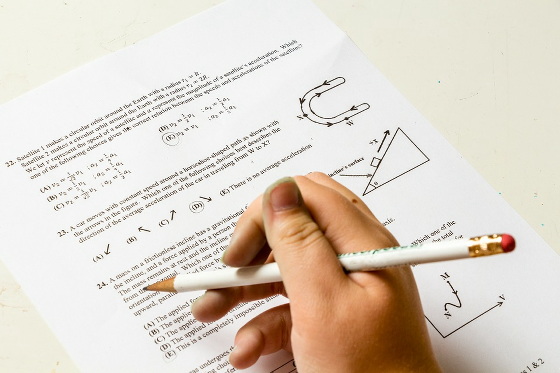
It is important in learning to not only see or hear information, but also to take advantage of the testing effect, which strengthens memory by occasionally recalling information.
This 'test' doesn't just refer to exams given regularly at school, but can also be a mini-test you take yourself to check your memory in your spare time. By being aware that tests are not just for checking what you remember, but also for checking what you have forgotten, you can improve your learning efficiency. This can also be more effective when used in conjunction with the 'dispersion effect,' which will be explained in the next section.
◆4: Utilize the diversification effect

By Alex The Shutter
When it comes to remembering something, it's more effective to periodically take in knowledge over a set period of time than to cram it all in intensively in a short period of time. This takes advantage of the 'dispersion effect,' a phenomenon first described by German psychologist Hermann Ebbinghaus . When humans learn something and then leave it for a while, if they learn the same thing again, the longer the time that passes, the stronger the memory of the second learning. This is also related to the forgetting curve , which is often mentioned when it comes to learning, and shows that repeated learning over a set period of time is important for retaining knowledge in the mind.
◆5: Use memory techniques

By
In Japan, to remember the order of the periodic table, we use phrases like 'Sailor Liebe, my ship, Seven Curved Ships, Clark?'. This is an effective technique for remembering things by using mnemonics to make the brain memorize the information in a special way.
In addition to mnemonics, there are other memory techniques such as the 'locus method,' which links knowledge with places, and the 'narrative method,' which converts multiple pieces of knowledge into a story and memorizes them along a timeline.Participants in the ' World Memory Championship ,' a competition to test their memory skills, also make use of these memory techniques.
By the way, a mnemonic equivalent to the Japanese 'horizontal liebe' in English-speaking countries is apparently based on the cartoon 'The Simpsons.' The 18th element, also known as the 'noble gases,' is listed in ascending order of atomic number as 'He,' 'Ne,' 'Ar,' 'Kr,' 'Xe,' and 'Rn.' Translated into Simpsons style, this becomes 'he never argues, Krusty, xenophobic runt,' a reference to the clown in the show (second from the left in the top row of the image below).

Related Posts: