It turns out there is no relationship between an engineer's ability and their educational background

By
Academic background is one of the most important evaluation criteria used by companies to recruit talented personnel. The rationale behind this is that 'they must perform well because they were able to attend a school with a high academic standard' or 'they must be receiving good stimulation from their surroundings at school.' However, research into the abilities of computer engineers has revealed that there is in fact no correlation between a high level of education and high ability.
We looked at how a thousand college students performed in technical interviews to see if where they went to school mattered. It didn't. – interviewing.io blog
http://blog.interviewing.io/we-looked-at-how-a-thousand-college-students-performed-in-technical-interviews-to-see-if-where-they-went-to-school-mattered-it-didnt/
The survey was conducted by interviewing.io , a platform that allows corporate recruiters and job seekers to conduct anonymous online interviews. This service is actually used by recruiters from companies such as Google, Facebook, Twitter, Amazon Web Services (AWS), and Microsoft, and allows job seekers looking for programming roles to match with recruiters based solely on skills . This allows companies to efficiently recruit a wide range of highly skilled candidates, while employers benefit by being able to advance through the selection process based solely on their own abilities, rather than relying on academic background.
free anonymous technical interview practice | free anonymous technical interview practice | interviewing.io
https://interviewing.io/
Interviewing.io, which is able to break down the barriers of educational background, race, and gender in this way, investigated the actual correlation between engineering skills and educational background. The company first classified US universities into four categories: 'Elite,' 'Top 15,' 'Top 50,' and 'Remainder,' and then collected statistics on how people in each cluster were evaluated. The breakdown of the four clusters is as follows:
・Elite : MIT (Massachusetts Institute of Technology), Stanford University, Carnegie Mellon University, University of California, Berkeley, etc.
Top 15 : University of Wisconsin, Cornell University, Columbia University, etc.
Top 50 : Ohio State University, New York University, Arizona State University, etc.
The rest : Michigan State University, Vanderbilt University, Northeastern University, University of California, Santa Barbara, etc.
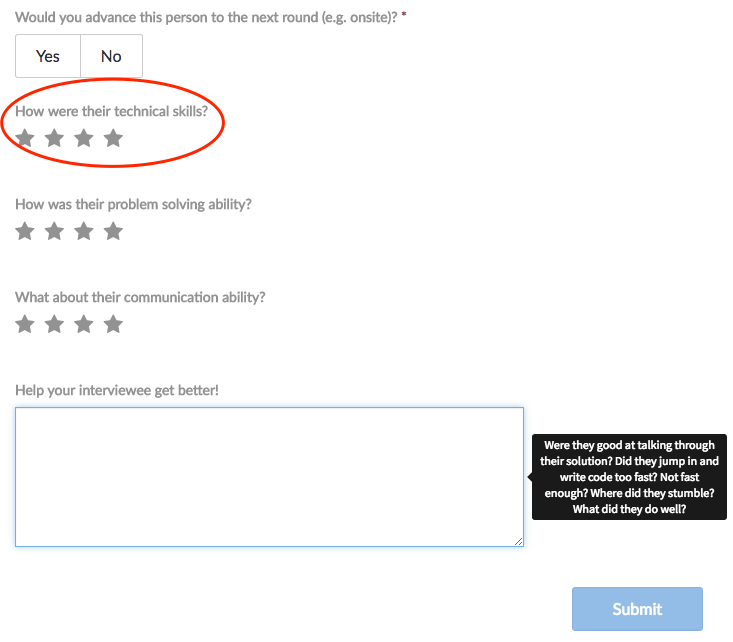
Furthermore, the survey divided each cluster into 'Junior' (current students/interns) and 'Senior' (new graduates) for statistics. The evaluation method is that those who pass the initial test on interviewing.io are then interviewed by a startup. This interview is conducted completely face-to-face and anonymously, so the company cannot learn anything about the applicant other than their skills. After the interview, the company's interviewer rates the applicant on a scale of 1 to 4, with 1 being the lowest.
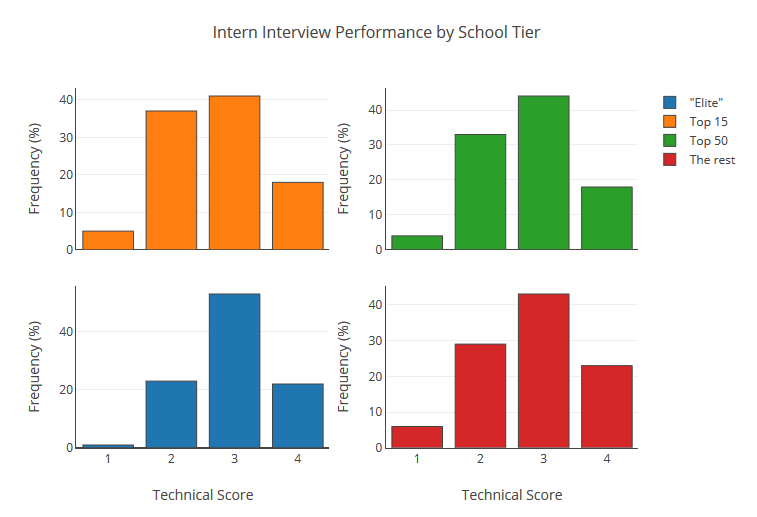
The following graph plots the ratings made in this way for each of the four clusters. First, if we line up the four ratings for Junior (current students/interns), we can see that in every cluster, the number of ratings '3' is the most common. It is also interesting to note that when the ratings are sorted by number, the order is perfectly consistent in every cluster: '3 → 2 → 4 → 1.'
Next, the graph for Seniors (new graduates) looks like this. The proportion of '3' is higher than for Juniors, and the difference between '2' and '4' is smaller, but the basic trend is almost the same as for Juniors.
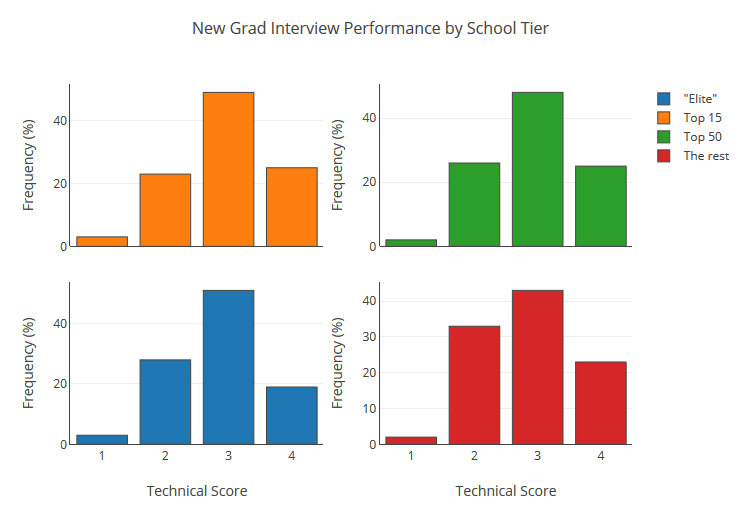
What's important about this evaluation method is that the graph shows absolute evaluations made by companies, rather than deviation scores that show the distribution within each cluster. In other words, it has become clear that the skills of job applicants are in fact almost unaffected by their educational background, and that talented people exist equally regardless of which educational cluster they belong to.
Related Posts: