What is the purpose of spreading 'biohacking,' which allows patients to make their own medicine, to the world?

by
The biohacking movement, in which individuals and small organizations study and conduct research in biology and life sciences outside of traditional research institutions, has been growing in recent years. Dave Asprey , the inventor of butter coffee, which became a hit in Japan, also identifies as a biohacker. One example of this biohacking is Michael Laufer, who provides information to help patients make their own medicine. Since he is disseminating 'information' rather than 'products,' Laufer's work is not subject to FDA enforcement. STAT , a medical and health news site, delves into his goals and vision.
An anarchist takes on Big Pharma — by promoting DIY prescription drugs
https://www.statnews.com/2017/10/12/michael-laufer-drug-prices/
An Anarchist Is Teaching Patients to Make Their Own Medications - Scientific American
https://www.scientificamerican.com/article/an-anarchist-is-teaching-patients-to-make-their-own-medications/
Mr. Lofer is the leader of an organization called Four Thieves Vinegar , and is the person who made the 'Epi Pencil,' an auto-injector for mitigating anaphylactic shock, available for DIY use for $30 (about 3,400 yen), 1/20 of the market price.
The image below shows Mr. Loafer holding his own Epi Pencil.
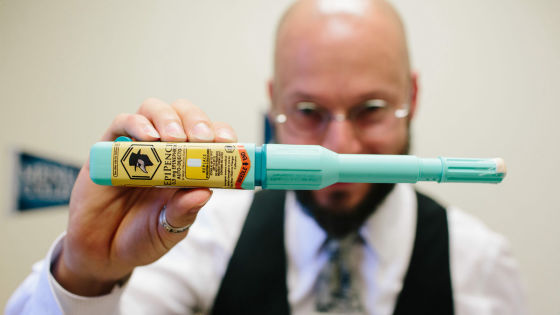
Laufer's goal is not just to make the Epi-Pencil, but also to create a 'desktop
While many experts warn against DIY drug-making, Laufer sees his work as a 'moral revolution' in an age when pharmaceutical companies are driving up drug prices so high they are out of reach for patients who need them. 'Denying patients access to life-saving medicines is murder,' he says. 'And stealing (intellectual property) to prevent murder is morally acceptable.'
#epipen pic.twitter.com/c4rCFGWC86
— Dr. Mixæl S Laufer (@MichaelSLaufer) August 26, 2016
'Emergency times call for emergency measures,' said Vinay Prasad, a professor at Oregon Health & Science University. He added that in the United States, where a year's supply of some drugs can cost as much as $750,000, 'it's foolhardy for patients to try to make their own medicine, but the emergence of people like Laufer is inevitable.'
According to STAT , who interviewed Lofer, the son of a journalist, Lofer is not in a financial position where he would need to make his own medicine. Dressed sharply in a jet black suit and paisley vest, Lofer teaches mathematics at Menlo College in California and lives in an upscale neighborhood. He studied particle physics at university and has mastered 18-19 languages, both modern and ancient. During his graduate studies, he was able to translate a French paper in a day out of necessity.
When asked, 'Who is your role model?', Laufer answered 'Gandhi' over champagne and sautéed scallops at an upscale French bistro, comparing Gandhi's Salt March of 1930 to his own actions against pharmaceutical monopolies.
'I don't want to be bound by the idea that an anarchist should be like this,' he said, adding that he wears a suit in his university classes to show his students that he takes his classes seriously. He also added that when he teaches mathematics in prisons, he wears leather instead of a suit because he needs to ride a motorcycle.
Laufer's turning point came a few years ago when he volunteered in El Salvador. He vividly remembers the moment when a nurse in a remote area said, 'We're out of antibiotics and pills.' Both were cheap generic drugs, but suppliers couldn't deliver them to the area quickly enough. 'This is ridiculous. They should be able to make the drugs in their own makeshift labs,' Laufer recalls.
Two years after that incident, Laufer launched a program to help disenfranchised patients make their own medications, as much as they need.
As of 2017, Laufer is exploring a DIY method for inexpensively producing the hepatitis C treatment drug 'sofosbuvir.' While treating hepatitis C with sofosbuvir, available from pharmaceutical company Gilead Sciences, would cost $84,000 (approximately ¥9.5 million), Laufer says that a DIY version could cost as little as $800 (approximately ¥90,000). Laufer's goal is to free up knowledge to save many lives. Gilead Sciences declined to comment on the matter.
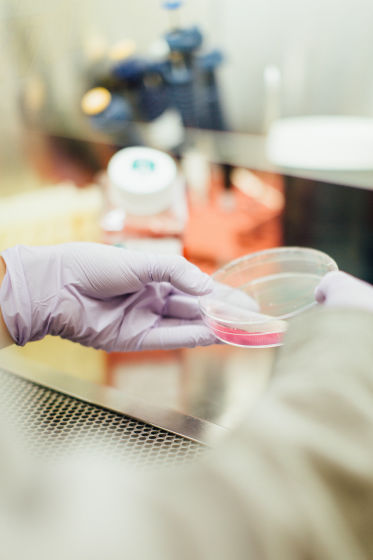
Laufer's team of experts, including doctors and others from various fields, are helping him develop a way to make life-saving medicines at home at low cost. None of them have spoken to him about it. 'They have different levels of paranoia about harassment and lawsuits,' Laufer says. Even Laufer doesn't want to reveal their real names for his own safety and that of his teammates. However, plans for a simple home lab are underway, with a beta version expected to be released sometime in 2017.
by
On the other hand, even the slightest mistake in the dosage of sofosbuvir can lead to serious risks such as contamination and overdose , making it a challenge for pharmaceutical companies. Josiah Zayner, CEO of ODIN , a former NASA synthetic biologist and biohacker, described Laufer's work as 'a proof-of -concept concept , the first step in a revolution.' While he praised the greatness of Laufer's recipes and lab work, he doesn't see Laufer's creations reaching the mass market. 'I don't know if Michael will change the world, but he's an icon,' Zayner said.
Laufer himself acknowledges that the market for home labs and DIY drugs is very narrow, with only those in desperate situations who cannot afford expensive drugs or those who enjoy experimenting. Laufer said, 'No one else would make their own drugs when drugs are readily available.' Even after he published the recipe for the Epi-Pencil on YouTube, it's unclear whether anyone actually made and used it. Additionally, several YouTube channels have pointed out several weaknesses in the DIY Epi-Pencil recipes he described.
But for Laufer, it's not the size of the market that's important, it's 'empowering patients who have no other options.'
Four Thieves Vinegar doesn't sell any products, but instead provides free advice and support, so it doesn't violate the law. Experts say this approach doesn't allow the FDA, which regulates drugs, to intervene.
Laufer said he wouldn't object if other entrepreneurs began selling 'micro-labs' like those proposed by Four Thieves Vinegar. In 2017, when political movements to change the situation are lacking, the fact that biohackers are spreading information about DIY drug-making and developing tools shows that Laufer's efforts are successful. However, he worries that DIY drug-making, which aims to avoid relying on doctors and pharmaceutical companies, could once again be seen as requiring skilled labor.
by Fabio Issao
Hank Greeley of Stanford University's Center for Law and Biosciences said of DIY drug-making, 'I'm happy to accept competent adults engaging in reckless and foolish behavior, as long as no one gets hurt.' However, if someone following in Laufer's footsteps dies as a result of his mistake, he believes there may be moral, if not legal, responsibility.
Laufer responded to Greeley's comments, saying, 'I feel more ethically responsible when people die because they don't have access to treatment. If I know how to make a life-saving drug and I don't tell the world about it, I feel like someone has died because of a crime I've been complicit in.'
As of press time, Laufer has not yet faced pressure from the FDA or the Pharmaceutical Research and Manufacturers of America (PhRMA). 'I'm not a big enough threat to them yet, but I'll keep trying,' he said.
Related Posts:

in Science, Posted by darkhorse_log