The claim that personalized learning methods based on 'learning styles' have little evidence

By
Based on the concept that each person has their own learning style, one methodology that has been advocated is to conduct research beforehand and then provide a learning method that is suited to each individual, known as a 'learning style.' However, there are many misunderstandings about this idea, and caution is being advocated, as it is not yet sufficiently supported as a theory.
No evidence to back idea of learning styles | Letter | Education | The Guardian
https://www.theguardian.com/education/2017/mar/12/no-evidence-to-back-idea-of-learning-styles
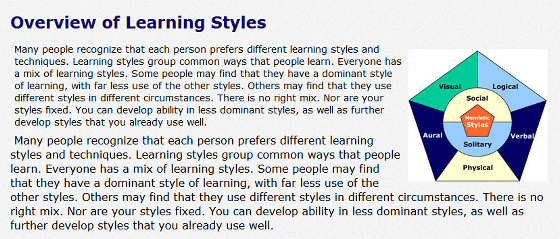
People often have different ways of thinking and perceiving things, such as 'right-brained vs. left-brained' or 'intuitive vs. theoretical,' and the idea that learning progresses better when people study in a style that suits them is known as 'learning style,' or in Japanese, 'study style.' Indeed, people have different ways of approaching things, such as 'diagram-based' or 'text-based,' 'focusing on the whole' or 'focusing on the specific,' and the idea of having people study in a way that suits them is considered to be logical, and this methodology is becoming more widespread around the world.
By
However, there are also those who believe that this method still has problems. There are three main reasons for this. The first is that there is no consistent framework for learning styles that can be adapted to each individual. Typically, when applying learning styles to individuals, they are determined based on a self-reported questionnaire to identify one of three learning styles: 'auditory,' 'visual,' or 'kinesthetic.' However, one study has revealed that there are a total of 70 types of learning styles, including 'right-brained vs. left-brained,' 'global vs. specific-focused,' and 'verbal vs. visual,' and the current classification of learning styles is considered insufficient.
Second, there is the negative effect of categorizing individuals into a particular style, which can lead to them becoming fixed and preventing them from adapting to other styles.

By
The biggest problem is that systematic research on the effectiveness of learning styles has found little or no evidence that tailoring learning to individuals' learning styles actually works. The UK's Educational Endowment Foundation has concluded that learning styles offer 'low-impact benefits, based on limited evidence and at very little cost.'
A group of British educational researchers has stated that learning styles are merely a 'neuroscientific myth,' and that attention should be focused on finding more fact-based learning methods. While it does not seem that the learning styles methodology itself has been completely rejected, there is no doubt that a methodology based on more solid evidence is needed.

By Sytyke ry
Related Posts: