The end of diploma mills

By 401(K) 2012
'Diploma mills' are institutions that do not provide education appropriate for degree-granting educational institutions, such as universities that grant degrees without sufficient time or that do not require students to actually attend school, or even self-proclaimed 'universities' that are not officially recognized as educational institutions. These are so-called 'money-to-buy degrees' institutions, and one such diploma mill has come under investigation by the US government.
Death of a Diploma Mill: University of Phoenix Going Down in Flames? - The Daily Beast
http://www.thedailybeast.com/articles/2015/07/31/death-of-a-diploma-mill-university-of-phoenix-going-down-in-flames.html
In 2003, the Japanese Ministry of Education, Culture, Sports, Science and Technology summarized the characteristics of diploma mills and the problems they pose.
Third International University Quality Assurance Research Collaborators Meeting - Handout 3: Regarding the 'Diploma (Degree) Mill' Problem
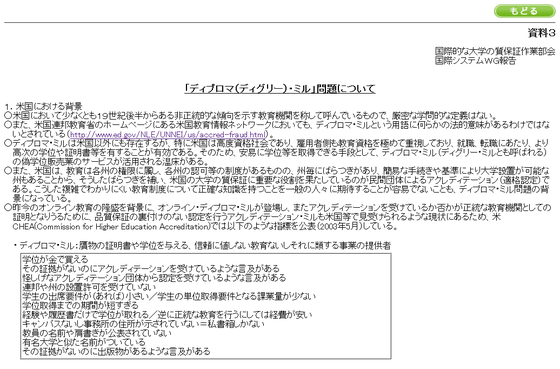
The characteristics of a diploma mill are as follows: In essence, it refers to an educational institution that is not worthy of a degree, or a business that is not even an educational institution.
Diploma mills: Unreliable providers of education or similar services that offer counterfeit certificates or degrees.
Money can buy a degree
There are references to accreditation without any evidence of it being true
There are references to being certified by a questionable accreditation organization.
No federal or state permits for installation
Low student attendance requirements (if any) / Low student credit load
The time it takes to complete a degree is too short
You can get a degree just with experience and a resume / Conversely, the costs are low for a formal education
No campus or office address given = only a post office box
The names and titles of the faculty members are not published.
It has a name similar to that of a famous university.
There are references to publications without any evidence of such.
The impact that the existence of diploma mills could have on Japan is as follows:
Specific situations in which diploma mills may occur
・Japanese universities and other institutions that partner with foreign 'universities' (diploma mills) without knowing that they are not recognized as legitimate universities in their respective countries may offer credit transfers, co-host events, and lend university-related facilities (which also reduces the reputation and credibility of Japanese universities themselves).
・Through the above-mentioned collaboration, the name of the school becomes known among Japanese students and Japanese society as a whole, without them realizing that it is a diploma mill.
- Similar to the promotional activities of American diploma mills in other countries, the names of famous people and university officials are included in lists of officers and faculty (without their permission), thereby spreading the name of the school among Japanese students and Japanese society as a whole.
・Other cases include the names of famous universities being imitated, and diplomas from famous universities being forged or imitated.
One such diploma mill is the University of Phoenix, a leading for-profit university in the United States known for its extensive online course offerings. The university's parent company, Apollo Education Group (Apollo), has announced that the Federal Trade Commission (FTC) has investigated the university and its other for-profit educational institutions. According to a report by CNNMoney , Apollo has stated that it will 'fully cooperate' with the FTC's investigation, which will include the past four years of financial and transaction information, as well as credentials and veteran enrollment information.
For-profit universities are different from public and private universities in that they are private companies that provide students with skills that will be useful for work, but in reality, many private companies are trying to exploit students' access to the federal scholarship program established by the US government to improve higher education. As a result, graduates of for-profit universities are burdened with a much higher rate of student loan debt than those from public or private universities.
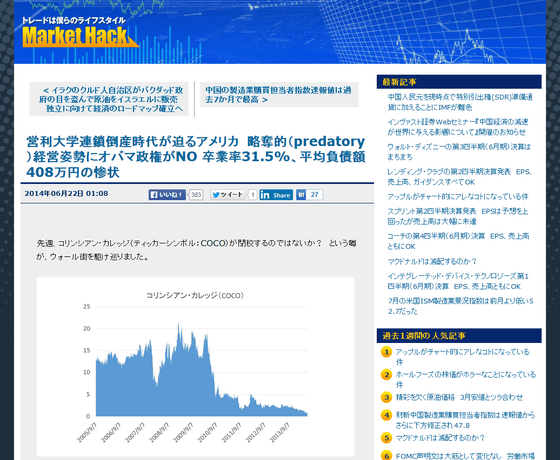
The following article provides detailed figures on the actual situation of for-profit universities and students in the United States. The percentage of students with student loan debt upon graduation from a four-year university is 66% for public universities, 75% for private/non-profit universities, and 88% for for-profit universities. The average student loan debt is 2.6 million yen for public universities, 3.3 million yen for private/non-profit universities, and 4.08 million yen for for-profit universities. In contrast, the graduation rate for four-year universities is 57.2% for public universities, 65.5% for private/non-profit universities, and 31.5% for for-profit universities.
America is on the brink of a wave of for-profit college bankruptcies. The Obama administration says no to predatory management practices. Graduation rates are 31.5% and average debt is ¥4.08 million. - Market Hack
One such for-profit university, the University of Phoenix, is under investigation for allegedly operating as a diploma mill. According to an Associated Press report , the University of Phoenix's online program has generated a total of $488 million in tuition from students other than those receiving GI Bill scholarships. Furthermore, according to a Center for Investigative Reporting (CIR) report , 24,000 veterans returning from the Iraq and Afghanistan wars enrolled in the University of Phoenix's online program in 2014, indicating a significant number of students enroll annually. In fact, a 2015 CNNMoney report found that while the number of students enrolled has declined by 54% over the past five years, the university still has approximately 213,000 students enrolled.
New government regulations now require educational institutions with vocational training programs to train scholarship recipients to the point where they can repay their scholarship loans. However, according to Department of Education data, the graduation rate for the University of Phoenix's online program is 7.3%, and 19% of students there are unable to repay their loans on their own, 5 percentage points higher than the national average.
Furthermore, in July 2015, the State of California requested that the University of Phoenix remove veterans from its online program due to their enrollment in violation of VA regulations. These VA regulations were established to prevent educational institutions from exploiting federal grants from veterans. Because the University of Phoenix enrolled many veterans in order to receive these grants, the state requested the removal of some veterans from its online program. Following the FTC audit, Senator Richard Durbin stated, 'While the FTC is investigating the University of Phoenix's practices, the fraudulent practices likely associated with the University of Phoenix are well known to occur at for-profit universities.'
U.S. Secretary of Education Arne Duncan said, 'We know that many colleges and universities have chosen to improve or discontinue substandard programs. But we believe we should take this approach more broadly to ensure students get what they pay for.'
Related Posts: