Six theories that may explain why eldest sons and daughters tend to achieve better grades

By
The sibling relationship in which the eldest son excels in sports and excels in academics, while the second son feels inferior and inferior to the eldest, is often seen in movies and TV dramas, but multiple studies have shown that birth order can affect academic performance. So, why exactly does birth order affect academic performance? Researchers who conducted the study have compiled six theories, published by The Atlantic .
First Children Are Smarter—but Why? - The Atlantic
http://www.theatlantic.com/business/archive/2013/10/first-children-are-smarter-but-why/280725/?single_page=true
Strategic Parenting, Birth Order and School Performance
http://www.nber.org/papers/w19542
Birth Order and Student Performance:Summary
http://www.nber.org/digest/mar14/w19542.html
According to a U.S. government survey (PDF file) conducted between 1990 and 2008 among mothers with children ages 10 to 14, 33.8% of children who achieved high grades in their class were eldest sons and daughters, with the percentage decreasing with age. Furthermore, among children who achieved average or below average grades, fourth sons and daughters had the highest percentage. In addition to this survey, a joint study by Duke University and the University of Washington also found that eldest sons and daughters tend to outperform their siblings.
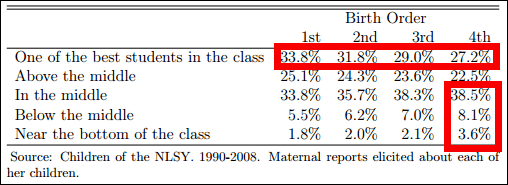
The researchers and economists who conducted the survey came up with the following six theories to explain why these results were obtained.
◆01: Divided attention theory

By
The more children a family has, the more divided their parents' attention becomes. Therefore, eldest sons and daughters, who have more time to focus their parents' undivided attention, tend to have better academic performance... This is the 'divided attention theory.'
◆02: Genetic theory
By
The 'genetic theory' suggests that children born later in life have less 'genetic talent' than eldest sons and daughters. The fact that eldest sons and daughters tend to have higher IQs than their siblings was pointed out in a paper published in 1973 called ' Birth Order, Family Size, and Intelligence .'
◆03: The 'Enough with the kids!' theory

By Samantha T.
The theory goes that when couples have multiple children and one becomes a handful, they decide 'enough is enough!' and stop having more children, and this 'handful' child turns out to be the youngest child, which results in data showing that 'younger children do not improve academically.'
◆04: Zero Teacher Theory

By
The 'zero teachers theory' states that eldest sons and daughters ultimately benefit by teaching their siblings about studying and discipline, while younger children lose out because they have no children born after them and therefore do not have the opportunity to teach.
◆05: Divorce theory

By
Divorce often occurs after the first child is born, and there is a possibility that subsequent children may not receive a sufficient education from their parents.
◆06: Lazy Parent Theory

By Justin
The theory is that parents who worked hard to raise their first child properly become tired of raising their second and third children, and the quality of their care and education declines.A joint study by Duke University and the University of Washington found that eldest sons and daughters receive stricter education than subsequent children in terms of television time and homework, suggesting that the lazy parent theory may not be entirely wrong.
These 'theories' are merely based on research findings. There are many exceptions, so it's important to avoid thinking like Jagi's , that 'there is no younger brother who is better than his older brother.'
Related Posts: